
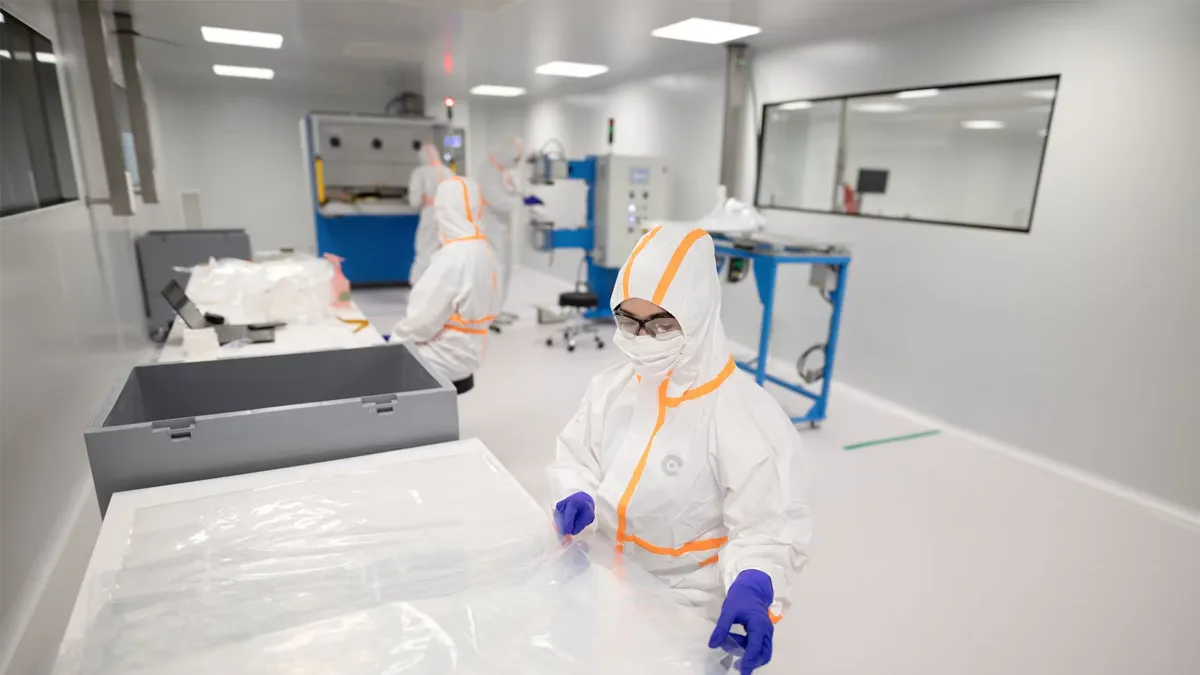
Pharmaceutical manufacturing sits at one end of the industrial lighting spectrum where the stakes are highest. A contaminated batch can cost millions. A non-compliant facility can face shutdown orders from the FDA or EMA. Lighting that contributes particles, generates excessive heat near temperature-sensitive products, or flickers in a way that impairs visual inspection is not just a nuisance — it is a regulatory problem.
This guide covers everything a facilities engineer, validation specialist, or procurement manager needs to specify LED lighting for pharmaceutical and cleanroom environments: GMP regulatory requirements, ISO 14644 classification levels, fixture design requirements, photometric targets, qualification documentation, and a step-by-step checklist for new installations and retrofits.
Why Pharmaceutical Facilities Cannot Use Standard Industrial LED Fixtures
General-purpose LED high bay and panel fixtures are designed for warehouses, factories, and offices. Pharmaceutical cleanrooms impose requirements that most standard fixtures simply cannot meet:
- Particle generation. Standard fixture housings have exposed seams, ventilation slots, and paint surfaces that shed particles into the airspace. In ISO Class 5–7 cleanrooms, every surface within the room boundary must be evaluated as a potential contamination source.
- Microbial harboring surfaces. Horizontal ledges, exposed fasteners, and recessed cavities collect particulates and moisture. Cleanroom fixtures must present smooth, sloped, or flush surfaces that wipe clean without retaining residue.
- Thermal output proximity to product. Some processing areas handle lyophilized biologics, active pharmaceutical ingredients (APIs), or filled vials that require temperature control within ±2°C. Fixture heat loads must be calculated and managed.
- Chemical resistance. Cleanroom surfaces undergo regular sanitization with isopropyl alcohol (IPA), hydrogen peroxide vapor (HPV), vaporized H₂O₂ (VHP), peracetic acid, or sodium hypochlorite. Fixture housings, lenses, and gaskets must resist these agents without degrading or off-gassing.
- Qualification documentation. FDA 21 CFR Part 211.68 and EU GMP Annex 1 (2023) require that all equipment in controlled areas be qualified through IQ/OQ/PQ protocols. Lighting is not exempt.
Regulatory Framework: What the Rules Actually Say
FDA 21 CFR Part 211 (cGMP for Finished Pharmaceuticals)
Section 211.44 states: “Adequate lighting shall be provided in all areas.” While that language is general, FDA guidance documents and Warning Letters establish that “adequate” means lighting that supports the specific visual task being performed — and that lighting equipment must not introduce contamination risk.
Section 211.42(c)(10) requires that lighting fixtures and air-handling systems in controlled areas be designed so they can be cleaned and do not contribute contamination. Inspectors routinely cite exposed bulb sockets, corroded housing, and fixtures with visible particle accumulation.
EU GMP Annex 1 (2023 Revision)
The 2023 revision of Annex 1 (Manufacture of Sterile Medicinal Products) introduced significantly more detailed requirements for cleanroom design. Key lighting-relevant provisions:
- Section 4.3 requires that all equipment — including lighting — be designed to minimize contamination risks and facilitate effective cleaning and decontamination.
- Fixture penetrations through cleanroom walls or ceilings must be sealed with materials compatible with decontamination procedures.
- The Contamination Control Strategy (CCS) document must address lighting as a potential contamination source and define cleaning frequency and method.
ISO 14644-1:2015 (Classification of Air Cleanliness by Particle Concentration)
ISO 14644-1 defines cleanroom classes based on maximum allowable particle concentrations at 0.5 µm and 5 µm particle sizes. The pharmaceutical industry uses ISO Classes 5 through 8, which map to EU GMP Grades as follows:
| ISO Class | EU GMP Grade | Max Particles ≥0.5 µm/m³ (at rest) | Typical Use |
|---|---|---|---|
| ISO 5 | Grade A/B | 3,520 | Aseptic filling, open vial handling |
| ISO 6 | Grade B | 35,200 | Background for Grade A operations |
| ISO 7 | Grade C | 352,000 | Less critical aseptic preparation |
| ISO 8 | Grade D | 3,520,000 | Non-sterile secondary packaging |
Every component in an ISO Class 5 room — including lighting fixtures — must be evaluated for particle shedding under ISPE Baseline Guide Volume 3 and your facility’s contamination control strategy.
Photometric Requirements by Area Function
The right light level depends on the visual task, not just the classification level. IESNA RP-29 (Lighting for Hospitals and Healthcare Facilities) and USP <1116> provide guidance on healthcare and pharmaceutical illuminance targets. Typical requirements:
| Flächenart | Illuminance Target (lux) | CRI Minimum | CCT Recommendation | Uniformity (min/avg) |
|---|---|---|---|---|
| Aseptic filling suite (ISO 5) | 1,000–2,000 | ≥90 | 4000–5000K | ≥0.7 |
| Cleanroom corridor (ISO 7–8) | 500–750 | ≥80 | 4000K | ≥0.6 |
| Visual inspection station | 2,000–3,000 | ≥90 | 5000–6500K | ≥0.8 |
| Weighing / dispensing | 750–1,000 | ≥85 | 4000K | ≥0.7 |
| Packaging lines | 500–750 | ≥80 | 4000K | ≥0.6 |
| Gowning rooms | 500–750 | ≥80 | 4000K | ≥0.6 |
| Cold storage (+2–8°C) | 300–500 | ≥80 | 4000K | ≥0.5 |
| Freeze storage (–20 to –80°C) | 200–300 | ≥70 | 4000–5000K | ≥0.5 |
Visual inspection stations are particularly demanding. FDA guidance on visual inspection of parenteral products (per USP <790> and <1790>) requires inspectors to distinguish particles, cracks, discoloration, and fill-level variations in vials and ampoules. Illuminance above 2,000 lux with CRI ≥90 and minimal veiling reflectance is the baseline; many facilities use dedicated inspection lamps at 3,000–5,000 lux on adjustable arms rather than relying solely on overhead lighting.
Flicker Requirements in Pharmaceutical Settings
Flicker is a particular concern in pharmaceutical manufacturing for two reasons:
- Visual inspection accuracy. The stroboscopic effect created by PWM-dimmed LEDs running at frequencies below 1 kHz can cause moving conveyor lines, rotating equipment, and particles in inspection vials to appear frozen or distorted. This compromises inspection reliability under FDA AQL sampling plans.
- Regulatory visibility. EU GMP inspectors increasingly assess lighting as part of contamination control audits, and visible flicker during inspection-line operations has appeared in Form 483 observations.
Specify fixtures with:
- Percent flicker <1% at all dim levels (IEEE 1789-2015 low-risk threshold)
- Flicker frequency ≥3,000 Hz if PWM dimming is used (eliminates stroboscopic effect below machine vision thresholds)
- Constant-current reduction (CCR) dimming preferred over PWM for inspection areas
Cleanroom Fixture Design Requirements
Housing Construction
The two dominant housing materials for pharmaceutical cleanroom lighting are:
Injection-molded polycarbonate (PC): The standard choice for ISO 6–8 areas. PC housings can be made smooth, seamless, and compatible with IPA and hypochlorite sanitizers. Limitations: susceptible to surface crazing over time with repeated IPA exposure at concentrations above 70%; not suitable for HPV decontamination at concentrations above 750 ppm.
304 or 316L stainless steel: Required for ISO Class 5 and Grade A/B zones, HPV decontamination compatibility, and applications with peracetic acid or strong oxidizers. 316L (low-carbon grade) provides better corrosion resistance than 304 in chloride-heavy environments. Electropolished finish (Ra ≤0.5 µm) is recommended for Grade A zones to minimize microbial adhesion.
Surface finish standards:
- Grade A/B (ISO 5–6): Electropolished 316L stainless, Ra ≤0.5 µm surface roughness
- Grade C (ISO 7): Polished PC or powder-coated aluminum, smooth with no horizontal ledges ≥5 mm
- Grade D (ISO 8): PC or standard aluminum, wipeable surface, no exposed fasteners
Sealing and IP Rating
Pharmaceutical cleanroom fixtures must be sealed against particle ingress from the plenum side and against cleaning agent ingress from the room side:
| Classification | Mindest-IP-Schutzart | Anmerkungen |
|---|---|---|
| ISO 5 (Grade A/B) | Mindestens IP65, bevorzugt IP66 | VHP decontamination compatibility required |
| ISO 6–7 (Grade B/C) | IP54 minimum, IP65 preferred | IPA and hypochlorite compatible gaskets |
| ISO 8 (Grade D) | IP44 minimum | Dust and splash protection |
| Wet areas / washdown | IP66–IP69K | Pressure washdown environments |
Gasket material selection is critical for decontamination compatibility:
- Silicone: Best general choice — resists IPA, hypochlorite, HPV up to 1,200 ppm, peracetic acid at moderate concentrations. Temperature range −60°C to +200°C.
- EPDM: Excellent ozone and oxidizer resistance. Good for H₂O₂ environments.
- PTFE (Teflon): Maximum chemical resistance including strong acids and concentrated H₂O₂. Use where other elastomers fail; higher cost.
- Avoid neoprene and natural rubber in pharmaceutical cleanrooms — degradation products can contaminate surfaces.
Ceiling Penetration and Sealing
Recessed fixtures that penetrate the cleanroom ceiling are a common contamination pathway. Best practices:
- Use fixtures specifically designed for recessed cleanroom installation with integrated ceiling seals — not standard commercial recessed downlights.
- Seal the ceiling penetration with a two-part silicone bead that can be removed and reapplied during maintenance without damaging the ceiling surface.
- All wiring entering the room through ceiling penetrations must be sealed with UL-listed fire-stop putty compatible with your ceiling assembly.
- Flush-mounted surface-mount fixtures (zero penetration) eliminate the contamination pathway entirely and are preferred in Grade A/B environments.
LED Driver Location Options
Three approaches to driver placement, each with trade-offs:
Integrated driver (driver inside fixture enclosure): Simplest installation. Creates heat build-up inside sealed fixture, reducing LED and driver lifespan. Acceptable for Grade C/D areas with ambient temperatures below 30°C. Not recommended for Grade A/B or hot process areas.
Remote driver (driver outside cleanroom): Optimal for Grade A/B areas. Driver is installed in the technical plenum above the cleanroom; only the LED module and sealed housing are in the controlled space. Eliminates driver heat from room, extends lifespan, simplifies maintenance (driver servicing does not require gowning). Requires plenum access strategy and longer LED driver wiring runs.
Above-ceiling remote driver: Variant of remote configuration where the driver is above the false ceiling. Suitable for ISO 7–8 areas where the ceiling is accessible without entering the cleanroom envelope.
Qualification Documentation: IQ/OQ/PQ for Cleanroom Lighting
Under FDA 21 CFR Part 211 and EU GMP Annex 15 (Qualification and Validation), all utilities and equipment in controlled manufacturing areas require a documented qualification approach. Lighting is classified as a utility system.
Installation Qualification (IQ)
IQ verifies that the lighting system was installed correctly as specified. Key IQ deliverables:
- Fixture identification and serial number records
- As-built drawing showing fixture positions, ceiling penetration seals, and conduit routing
- Electrical panel schedules and circuit assignments
- Lamp/driver specifications vs. approved design documents
- Calibration certificate for illuminance meter used during OQ
- Gasket material certification of compliance (COC) matching qualified material
Operational Qualification (OQ)
OQ verifies the system operates within specified parameters under normal and challenge conditions:
- Illuminance mapping per IES LM-41 using calibrated lux meter — minimum 9-point grid per room, 25-point for rooms ≥50 m²
- Uniformity calculation (minimum/average ratio)
- Flicker measurement at full output and at each programmed dim level
- Color temperature verification at representative fixture sample (min 10% or 5 fixtures)
- Emergency lighting activation test and minimum lux verification
- Switch and control system function test
Performance Qualification (PQ)
PQ verifies the system maintains specifications over time and under operational conditions:
- Illuminance re-measurement after 3-month and 12-month intervals to assess lumen depreciation
- Fixture integrity inspection post-VHP decontamination cycle (check for gasket degradation, lens clouding)
- Particle count correlation study: verify that fixture installation or maintenance events do not cause particle count excursions in the ISO classification zone
Energy Efficiency in Controlled Environments
Pharmaceutical facilities often overlook lighting energy in favor of HVAC optimization — a mistake, given that lighting heat load is a direct input to cooling calculations. In an ISO Class 7 cleanroom at 15 air changes per hour, reducing lighting heat output by 2 W/m² can reduce cooling demand by approximately 3.5 W/m² once air-side efficiency is accounted for.
Typical Energy Comparison
| Lighting Technology | Power Density (W/m²) | Illuminance at 3m (lux) | Heat Load (W/m²) | L70 Life |
|---|---|---|---|---|
| T8 Fluorescent (grid-mounted) | 18–22 | 500–700 | 18–22 | 20,000 hrs |
| T5HO Fluorescent (high output) | 16–20 | 600–800 | 16–20 | 20,000 hrs |
| Cleanroom LED (standard) | 8–12 | 500–750 | 8–12 | 60,000 hrs |
| Cleanroom LED (high efficacy) | 6–9 | 500–750 | 6–9 | 70,000 hrs |
A 500 m² ISO Class 7 manufacturing suite with 20 W/m² fluorescent lighting consumes 10,000 W for lighting alone. Replacing with 9 W/m² LED reduces that to 4,500 W — saving 5,500 W continuously. At $0.12/kWh operating 6,000 hours/year, that is $3,960/year in electricity savings, plus a meaningful reduction in cooling load.
DLC Qualification for Rebate Programs
DesignLights Consortium (DLC) QPL-listed cleanroom luminaires qualify for utility rebates in most US states. DLC Premium qualification requires efficacy ≥120 lm/W, which most modern cleanroom LED panels meet. Document the DLC listing number in your procurement specification to ensure rebate eligibility before purchase.
Maintenance Strategy and Change Control
Lighting maintenance in a pharmaceutical cleanroom is not a simple lamp change. It is a change-controlled activity that may require:
- Environmental monitoring during the maintenance window to detect particle excursions
- Gowning at the appropriate classification level before entering the room
- Post-maintenance cleaning and sanitization of the fixture exterior
- Documentation in the room logbook and maintenance management system (CMMS)
- Re-qualification if a fixture is replaced with a different model (even same manufacturer)
LED lifespan advantage: A cleanroom LED fixture rated L70 at 70,000 hours requires roughly one-third the maintenance interventions of a T5HO fluorescent system rated at 20,000 hours. Over a 10-year period at 6,000 operating hours/year, that means approximately 2 LED replacements vs. 9 fluorescent replacements per fixture — each avoided replacement eliminates a change-controlled maintenance event, an environmental monitoring window, and an entry in the qualification deviation log.
Planning Maintenance Without Production Impact
Three scheduling strategies minimize production disruption:
- Group replacement at scheduled downtime. Replace all fixtures in a suite during planned facility shutdowns (annual or biannual). Use LED systems with sufficient rated life that the replacement interval aligns with existing shutdown cycles.
- Zoned maintenance windows. If the facility operates continuous manufacturing, divide the room into maintenance zones. During each zone’s window, temporarily increase lighting from adjacent zones to maintain illuminance specifications, document the deviation, and complete maintenance within the approved window.
- Plenum-side driver access. Remote-driver configurations allow driver servicing without entering the cleanroom — no gowning, no environmental monitoring, no room logbook entry. This is the single largest maintenance advantage of remote-driver design.
Hazardous Location Considerations in Pharmaceutical Manufacturing
Solvent-based manufacturing areas — particularly in API synthesis, tablet coating, and solvent recovery — are classified as hazardous locations under NFPA 70 (NEC) Article 500 or IEC 60079:
- NEC Class I, Division 1/2 (or Zone 0/1/2 under IEC) covers areas with flammable vapor or gas — typical for solvent dispensing, tablet coating with organic solvent, and solvent recovery systems.
- NEC Class II, Division 1/2 covers areas with combustible dust — relevant for dry powder API handling, granulation, and spray drying.
LED fixtures for pharmaceutical hazardous locations must carry UL 844 (luminaires for hazardous locations) or ATEX/IECEx certification, in addition to meeting cleanroom construction requirements. These dual-certified fixtures exist but are significantly more expensive — budget approximately 3–5× the cost of standard cleanroom luminaires.
Specification Checklist: LED Lighting for Pharmaceutical Cleanrooms
- Identify ISO classification level and EU GMP grade for each room
- Map visual tasks (inspection, filling, weighing, packaging) and set illuminance targets per IESNA RP-29
- Specify housing material: 316L electropolished stainless for Grade A/B; PC or aluminum for Grade C/D
- Specify IP rating: IP65+ for Grade A/B; IP44+ for Grade D with escalation for washdown
- Confirm gasket material compatibility with all sanitizers and decontamination agents in use
- Specify surface finish Ra ≤0.5 µm for Grade A/B electropolished stainless
- Decide driver location: remote driver for Grade A/B; integrated acceptable for Grade C/D below 30°C ambient
- Specify flicker: Percent flicker <1% at all dim levels; CCR dimming preferred for inspection areas
- Specify CRI ≥90 for inspection and filling areas; ≥80 for corridors and packaging
- Confirm DLC QPL listing for energy rebate eligibility
- Define IQ/OQ/PQ protocol and assign responsible party (facilities engineering vs. validation)
- Confirm hazardous location classification; specify UL 844 or ATEX if required
- Define maintenance interval aligned with facility shutdown schedule
- Confirm ceiling penetration sealing strategy and material compatibility with cleanroom construction
Häufige Fehler bei der Spezifikation
1. Using commercial recessed LED troffers in cleanroom ceilings. Standard office troffers have ventilation slots, plastic lenses with exposed edges, and no IP rating. They shed particles, harbor microorganisms in cavities, and fail decontamination procedures. Always specify fixtures designed specifically for cleanroom use.
2. Specifying IP rating without checking gasket material compatibility. An IP65 fixture with a neoprene gasket may pass IP testing with water but fail after three HPV decontamination cycles as the gasket swells and loses sealing performance. The IP rating and the chemical compatibility of the seal are two separate specifications.
3. Omitting lighting from the IQ/OQ protocol scope. Lighting is a critical utility in pharmaceutical manufacturing. Omitting it from qualification documentation invites FDA Form 483 observations — particularly for areas used for visual inspection of finished product.
4. Selecting integrated-driver fixtures for Grade A/B hot environments. Aseptic filling suites often run at elevated temperatures (22–24°C), and Grade A zones near filling lines can see localized temperatures of 28–30°C near HVAC supply diffusers. Integrated drivers in these conditions operate at or above their maximum rated ambient, accelerating lumen depreciation and increasing failure rates.
5. Failing to verify flicker performance at dim levels. Many LED fixtures maintain acceptable flicker at 100% output but exhibit severe PWM flicker at 30–50% output — the level many occupancy-controlled systems select during low-activity periods. Test and specify flicker at all intended operating points, not just full power.
Häufig gestellte Fragen
Q: Do LED fixtures require re-qualification every time a driver or lamp module is replaced?
A: Under FDA and EU GMP change control requirements, any equipment modification in a classified area triggers a change assessment. Replacing like-for-like components (same part number, same firmware version) typically qualifies as a minor change requiring only IQ-level documentation. Replacing with a different component requires at minimum an impact assessment and may trigger partial OQ — particularly if the light output, color temperature, or flicker characteristics differ from the qualified baseline.
Q: Can standard commercial LED panels be used in Grade D (ISO Class 8) packaging areas?
A: Grade D areas have less stringent construction requirements than Grades A–C, and some facilities do use commercial-grade panels with additional sealing. However, FDA inspectors apply a risk-based approach — if the Grade D area handles open or in-process product that could be contaminated by particle shedding from fixtures, the standard for fixture construction rises accordingly. Consult your quality team before specifying commercial panels in any classified area.
Q: What color temperature is recommended for visual inspection areas?
A: USP <1790> and ASTM E2804 recommend white light at 5000–6500K for parenteral visual inspection to maximize contrast between particles and the liquid medium. The higher CCT (cool white) reduces yellowish adaptation effects that occur under warmer light and makes fine particles more visible against clear and light-colored solutions.
Q: How do LED fixtures affect particle counts during installation?
A: Any ceiling work in a classified area — including fixture installation — generates particles from cutting, fastening, sealant application, and personnel movement. All cleanroom construction and fixture installation should occur before the initial classification study, followed by a thorough cleaning and at least 24 hours of HVAC operation before particle count certification. For retrofits in active facilities, perform installation during a planned environmental monitoring exclusion window and conduct a particle count certification sweep before returning the room to production.
Q: Is there a standard for LED lighting specifically in pharmaceutical cleanrooms?
A: No single standard addresses LED lighting specifically in pharmaceutical cleanrooms. The applicable framework draws from FDA 21 CFR Part 211, EU GMP Annex 1 (2023), ISO 14644-1 (cleanroom classification), IESNA RP-29 (healthcare and pharmaceutical illuminance), IEC 60598-1 (luminaire safety), and DLC QPL (energy efficiency). Your facility’s validation master plan should reference this framework and specify how each standard applies to the lighting qualification scope.