
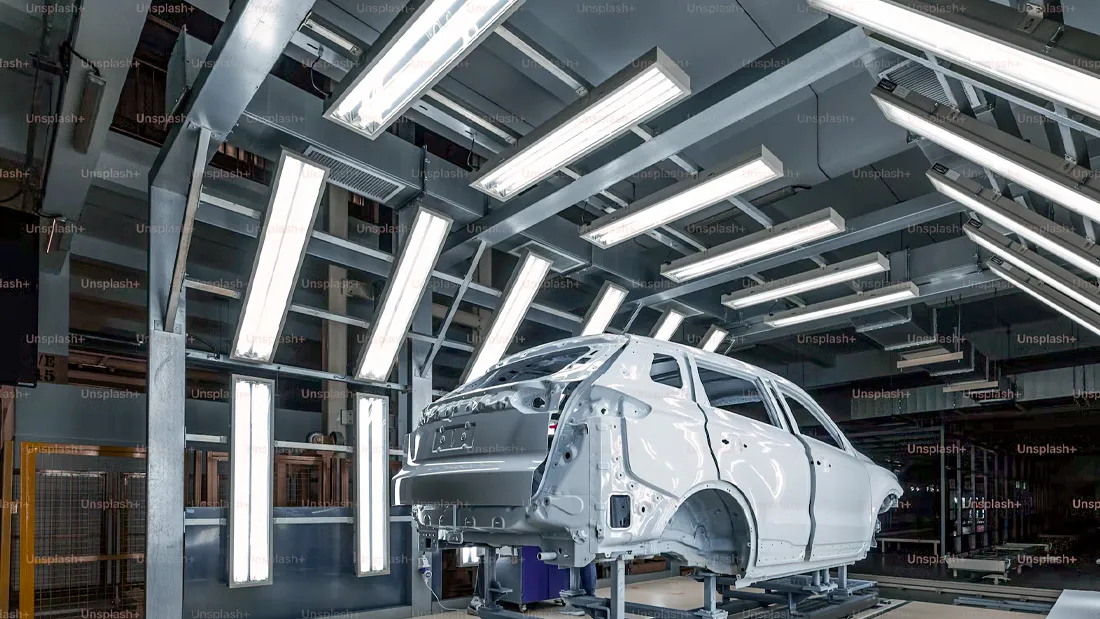
Poor lighting is quietly costing industrial businesses millions of dollars every year – not just in energy bills, but in reduced worker output, increased error rates, and preventable accidents. A growing body of research confirms that the quality of workplace lighting directly shapes how workers feel, how accurately they perform tasks, and how long they can sustain focus before fatigue sets in.
For facilities making the shift from outdated metal halide, high-pressure sodium, or fluorescent systems to LED technology, the productivity gains often rival – or even exceed – the well-publicized energy savings. This article examines what the science says, what field data from real industrial deployments shows, and how to make lighting decisions that deliver measurable returns on your workforce’s performance.
The Physiology Behind Light and Work Performance
Human biology is tightly coupled to light. The circadian rhythm – the internal clock governing sleep, alertness, hormone secretion, and mood – relies heavily on light exposure to stay synchronized. In outdoor environments, natural daylight handles this calibration automatically. Inside a factory or warehouse, the quality of artificial lighting takes over that role entirely.
Three physiological pathways are directly affected by workplace lighting:
1. Melanopsin-Based Alertness Signaling
Specialized retinal cells called intrinsically photosensitive retinal ganglion cells (ipRGCs) detect blue-spectrum light (roughly 460 – 90 nm) and send signals to the suprachiasmatic nucleus, the brain’s circadian pacemaker. Strong blue-enriched light during working hours suppresses melatonin, increases cortisol, and keeps workers alert. Older HID and incandescent systems emit very little in this spectrum. High-quality LED fixtures, by contrast, can be tuned to deliver precisely the right spectral output.
2. Visual Acuity and Task Accuracy
Industrial tasks – reading gauges, inspecting welds, sorting components on an assembly line – require sufficient illuminance (measured in lux) and high color rendering (measured by the Color Rendering Index, or CRI). Studies from the Lighting Research Center at Rensselaer Polytechnic Institute show that raising illuminance from 300 lux to 750 lux in assembly tasks reduces defect rates by an average of 23 – 2%. LEDs achieve consistent, high-lux output without the lumen depreciation that plagues metal halide lights after 6,000 – 10,000 operating hours.
3. Eye Strain and Sustained Concentration
Glare and flicker are two major contributors to visual discomfort in industrial settings. Conventional fluorescent and older LED drivers operating at lower frequencies produce flicker that the conscious eye may not detect but the visual cortex registers as stress. The result is accelerated eye fatigue, headaches, and reduced sustained attention. Modern LED systems with high-frequency or flicker-free drivers eliminate this effect almost entirely.
What the Research Actually Shows
Several landmark studies have quantified the relationship between upgraded lighting and worker output:
- A 2014 study by the American Society of Interior Designers found that 68% of employees reported dissatisfaction with their workplace lighting, and those with inadequate lighting showed 15 – 0% lower task performance scores compared to counterparts in well-lit environments.
- Research published in the Journal of Environmental Psychology (2018) demonstrated that workers under 5000K, high-CRI lighting completed fine assembly tasks 11% faster and with 18% fewer errors than those under 3000K lighting of the same lux level.
- A controlled trial at a German automotive plant replacing 400W metal halide high bays with 200W LED equivalents recorded a 9.4% improvement in line throughput and a 14% reduction in quality rejects within three months of the retrofit.
- NIOSH field studies in U.S. warehouses have consistently linked substandard lighting (below 200 lux in pick zones) with a 30 – 0% higher incidence of picking errors and a 22% higher near-miss accident rate.
Key Lighting Metrics That Drive Productivity
Not all LED upgrades are equal. Several specific photometric parameters determine whether a new lighting installation will actually improve worker performance:
Illuminance Levels (Lux)
The Illuminating Engineering Society (IES) publishes recommended illuminance values for different industrial task types:
| Task Type | Recommended Illuminance (lux) | Typical Industrial Setting |
|---|---|---|
| General area lighting | 200 – 00 lux | Storage, corridors, parking areas |
| Medium assembly / inspection | 500 – 50 lux | General manufacturing, packaging lines |
| Fine assembly / quality control | 1,000 – 2,000 lux | Electronics assembly, precision machining |
| Very fine visual work | 2,000 – 5,000 lux | Jewelry, microelectronics, surgical instruments |
Color Rendering Index (CRI)
CRI measures how accurately a light source renders colors compared to natural sunlight (CRI 100). For most industrial applications, a minimum CRI of 80 is required; for color-critical inspection tasks, CRI >= 90 is strongly recommended. Many utility-grade LED fixtures ship with CRI 70 – 5 – technically functional but suboptimal for anything involving visual discrimination.
Color Temperature (CCT)
Color temperature affects alertness and mood. Research suggests:
- 4000K’000K (neutral to cool white): Optimal for active work zones, assembly lines, and any area requiring sustained attention.
- 5000K’500K (cool daylight): Best suited for inspection stations and detail work where visual acuity is critical.
- 3000K’500K (warm white): Appropriate for break rooms and areas where workers need to decompress.
Uniformity Ratio
Uniformity – the ratio of minimum to average illuminance across a work surface – is often overlooked but critically important. IES recommends a minimum uniformity ratio of 0.7:1 for manufacturing environments. Poor uniformity forces workers’ eyes to constantly readjust, causing visual fatigue far more rapidly than a lower but uniform light level would.
Glare Control (UGR)
The Unified Glare Rating (UGR) quantifies discomfort glare from luminaires. For most industrial work, a UGR below 22 is the standard target. Well-designed LED high bays with prismatic diffusers can achieve UGR values of 16 – 9 in conditions where equivalent HID fixtures would measure UGR 28 – 2.
Real-World Case Studies: LED Retrofits and Productivity Outcomes
Case Study 1: Automotive Parts Manufacturing Plant, Ohio
A 280,000 sq ft facility replaced 580 units of 400W metal halide high bays with 200W LED equivalents. Post-installation measurements showed average illuminance rose from 320 lux to 680 lux at assembly floor level. Results over 12 months:
- Assembly line reject rate dropped from 4.2% to 2.9% (31% reduction)
- Reported eye strain complaints fell by 67%
- Absenteeism due to headaches and visual discomfort dropped 22%
- Energy costs for lighting fell 58%
Case Study 2: Cold-Storage Distribution Center, Texas
A 400,000 sq ft refrigerated warehouse replaced fluorescent tube arrays with IP65-rated LED high bays for cold-storage operation. LED fixtures were at 100% output instantly versus 15 – 0 minute warm-up for metal halide. Outcomes:
- Order picking accuracy improved 19% (measured by mis-picks per 10,000 orders)
- Forklift near-miss incidents in loading zones dropped 34%
- Worker satisfaction scores on lighting adequacy rose from 54/100 to 88/100
- Annual lighting energy cost reduced by $70,000
Case Study 3: Food Processing Facility, California
After replacing 250W HPS fixtures with 150W CRI-90 LED panels in inspection zones:
- Internal quality control catch rate for surface defects improved 28%
- Passed FDA visual inspection audit with zero lighting-related citations
- Workers reported the facility felt cleaner and safer
Flicker: The Hidden Productivity Killer
Flicker deserves dedicated attention because it is frequently misunderstood. Many facility managers believe flicker is only an issue if visible to the naked eye. In reality, the biological stress response to high-frequency flicker can occur at much higher rates than visible detection thresholds.
Fluorescent lighting driven by magnetic ballasts typically flickers at 100 – 20 Hz. A 2019 study in Ergonomics found workers in flicker-free LED environments reported 31% lower incidence of headaches over an eight-hour shift and performed sustained attention tasks 14% more accurately by the final hour compared to workers under fluorescent lighting.
When evaluating LED fixtures, look for Percent Flicker below 10% and Flicker Index below 0.1 in the photometric data sheet.
Calculating the Productivity-Side ROI
Most LED retrofit ROI calculations focus exclusively on energy savings. Adding productivity benefits creates a far more compelling business case. Example for a 100-worker facility, /hr loaded labor cost, 250 working days/year, 8-hour shifts:
- Annual labor cost: 100 workers x $25/hr x 8 hours x 250 days = $5,000,000
- 5% productivity gain = $250,000/year
- Energy savings (60% reduction): $90,000 – $150,000/year
- Reduced defect/rework cost: $40,000 – $100,000/year
- Total annual benefit: $250,000 – $600,000
Against a retrofit cost of $200,000 – $350,000 for a 100,000 sq ft facility, the simple payback period including productivity benefits drops to under 12 months – versus 2 – years when calculating energy savings alone.
Choosing the Right LED High Bay for Productivity Applications
When selecting LED high bay fixtures for workforce productivity applications, these specifications matter most:
- Efficacy >= 150 lm/W: Ensures adequate light levels without excessive wattage
- CRI >= 80 (>= 90 for inspection): Supports accurate color discrimination
- CCT 4000K’000K: Optimal alertness range for most production work
- Flicker-free driver (>= 20 kHz): Eliminates biologically relevant flicker
- UGR <= 22: Minimizes discomfort glare
- IP65 or higher: Suitable for dusty or wet industrial environments
- L70 lifespan >= 50,000 hours: Avoids gradual lumen depreciation
- 0 – 0V dimming capability: Enables smart control integration
Recolux industrial LED high bay fixtures are engineered to meet all of these parameters, with models spanning 100W to 400W to cover mounting heights from 5 to 20 meters. Each fixture undergoes photometric testing to IES LM-79 standards, providing accurate lux data for lighting design calculations.
Implementation Roadmap
- Lighting audit: Measure existing illuminance levels across the facility using a calibrated lux meter. Document low-performance zones and areas with high defect or accident rates.
- Photometric modeling: Use DIALux or AGi32 software to model proposed LED layouts before purchasing.
- Pilot zone deployment: Install LED fixtures in one production zone and measure results over 30 – 0 days before full rollout.
- Full facility rollout: Phase deployment to minimize production disruption. Many facilities choose weekend installation windows.
- Post-installation verification: Remeasure lux levels and uniformity after installation. Commission dimming and sensor controls.
- Ongoing monitoring: Track productivity and quality metrics for 6 – 2 months post-installation to quantify actual ROI.
Conclusion
The business case for industrial LED lighting has always been straightforward on the energy side. What is increasingly clear is that the workforce productivity dimension may be even more valuable. When workers operate in properly illuminated environments with the right lux levels, accurate color rendering, appropriate color temperature, and flicker-free output, they perform more accurately, fatigue more slowly, make fewer errors, and report higher job satisfaction.
Industrial facilities investing in LED upgrades that prioritize photometric quality – not just wattage reduction – position themselves to capture the full spectrum of returns: lower energy costs, reduced maintenance burden, and a more productive, more engaged workforce.
If you are evaluating LED high bay options for your facility, Recolux’s industrial LED lineup offers fixtures designed to meet the photometric specifications that drive real productivity improvements. Contact our team for a photometric design consultation or to request specifications for your specific application.

 English
 Spanish
 French
 German
 Arabic
 Russian