
Introduction
Educational facilities present unique lighting challenges that differ significantly from offices, industrial spaces, or retail environments. A classroom must support reading, writing, projection, and hands-on activities—all within the same space. A university lecture hall must ensure visibility for 300 students while minimizing glare on projection screens. A library must balance task illumination for intensive reading with ambient light that creates a calm, focused atmosphere.
Lighting in educational settings directly affects student performance, visual comfort, attendance, and even behavior. Poor lighting contributes to eye strain, headaches, fatigue, and reduced concentration—undermining the core mission of any educational institution.
This guide provides a comprehensive framework for designing, specifying, and implementing LED lighting systems in educational facilities, from K-12 schools to university campuses.
The Impact of Lighting on Learning Outcomes
Visual Performance and Academic Achievement
Multiple studies have established a link between lighting quality and student performance:
- Reading speed and comprehension: Students in classrooms with adequate illuminance (500 lux) and low glare perform 10–20% better on reading tasks than those in poorly lit classrooms.
- Test scores: Daylit classrooms are associated with 5–14% higher standardized test scores, depending on grade level and subject.
- Attendance: Students in classrooms with high-quality lighting have 3–4% better attendance rates, likely due to reduced headaches and eye strain.
- Behavior: Harsh, poorly distributed lighting is correlated with increased hyperactivity and disruptive behavior, particularly in younger students.
Circadian Entrainment and Student Wellbeing
Students—especially adolescents—are vulnerable to circadian misalignment. Early school start times conflict with adolescent biological rhythms, and lighting can either help or hinder circadian health.
- Morning light exposure: Cooler CCT (5000–6500K) in the morning helps reset circadian rhythms and improve alertness.
- Afternoon lighting: Neutral CCT (3500–4000K) supports sustained concentration without overstimulation.
- Evening activities: Warmer CCT (2700–3000K) in evening study areas aligns with natural circadian wind-down.
Lighting Design Principles for Educational Spaces
Uniformity and Glare Control
In educational spaces, uniformity is critical. A student sitting near a window should experience similar light levels to a student sitting in the center of the room.
- Uniformity ratio (minimum/average illuminance): Aim for >0.6 in classrooms.
- UGR (Unified Glare Rating): Keep below 16 in classrooms and lecture halls. Glare from overhead fixtures can reflect off glossy textbooks and tablet screens, causing discomfort and reduced reading speed.
- Luminance ratios: The ratio of task illuminance to surrounding area should not exceed 3:1 to avoid adaptive glare when looking between task and surroundings.
Flicker and Temporal Light Modulation
Flicker—even at frequencies invisible to the naked eye—can cause headaches, fatigue, and reduced concentration. All LED fixtures in educational facilities must have: – Flicker percent: <5% (preferably <1%). – Stroboscopic Effect Visibility Measure (SVM): <0.4 (preferably <0.1). – Driver type: Use DC (direct current) drivers or high-frequency AC drivers (>20,000 Hz).
Color Quality for Learning Environments
- CRI (Color Rendering Index): Minimum 80, preferred 90+ in art classrooms, science labs, and areas where color discrimination is important.
- R9 value (saturated red rendering): >50 for art and design classrooms.
- Consistency: Use fixtures with tight color binning (3-step MacAdam ellipse) to avoid noticeable color differences between fixtures.
Space-by-Space Lighting Recommendations
Classrooms (K-12 and Higher Education)
Classrooms are multipurpose spaces used for lectures, discussions, individual work, and increasingly, digital learning.
Illuminance targets: | Task | Recommended Illuminance (lux) | |——|——————————-| | General classroom activities | 300–500 | | Reading and writing (desk tasks) | 500 | | Whiteboard/chalkboard teaching | 500 (with specific board lighting) | | Computer work | 300–500 (with anti-glare screens) |
Fixture recommendations: – Recessed LED volumetric troffers: Provide uniform ambient light with low UGR. – Direct/indirect suspended linear fixtures: Create a more residential, comfortable feel; indirect component bounces light off the ceiling for soft, diffuse illumination. – Adjustable board lighting: Dedicated fixtures aimed at whiteboards/blackboards to ensure high contrast and readability from all seats.
Controls: – Daylight harvesting: Dim fixtures near windows to maintain consistent light levels. – Occupancy sensing: Automatically turn off lights when the room is unoccupied. – Scene control: Different lighting scenes for lectures, group work, and AV presentations.
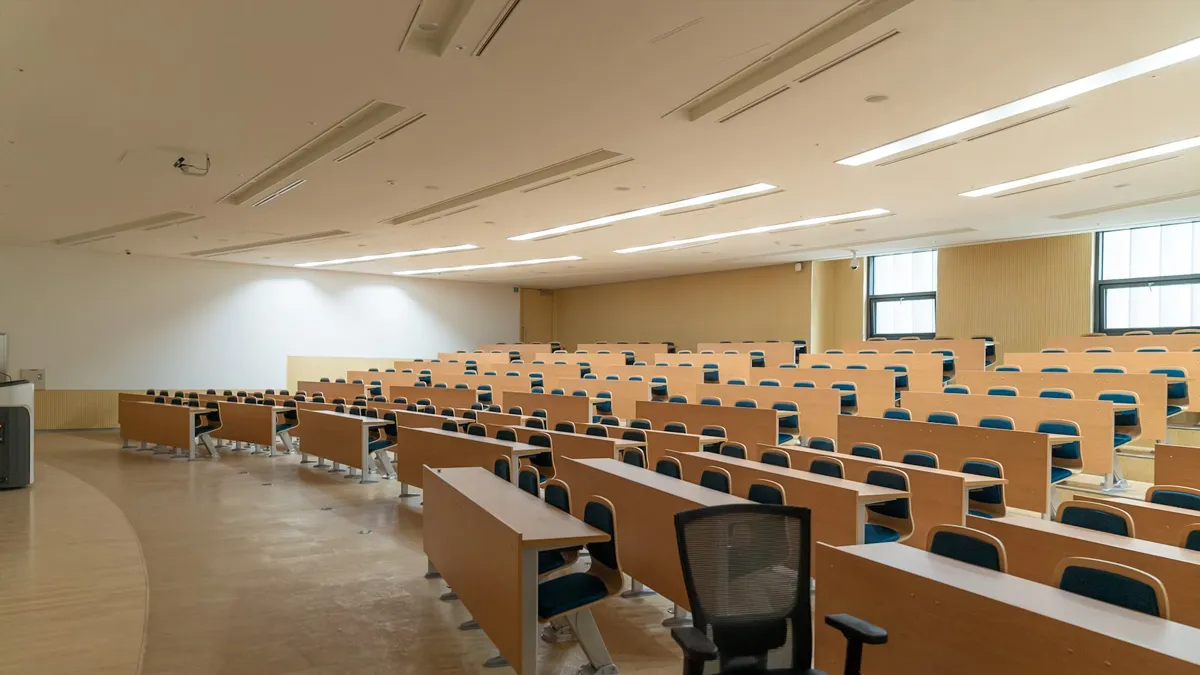
Lecture Halls and Auditoriums
Lecture halls present the challenge of lighting a large space with varying seat heights, projection screens, and diverse activities.
Illuminance targets: | Area | Recommended Illuminance (lux) | |——|——————————-| | Lecturer podium | 500–750 | | Note-taking surfaces | 300–500 | | Aisles and exits | 100 (minimum for safety) | | Projection screen area | <50 (during AV use) |
Fixture recommendations: – Asymmetric distribution fixtures: Push light toward the back of the hall while avoiding screen washout. – Aisle lighting: Low-level step lighting integrated into seating or floor for safe egress. – Podium lighting: Adjustable accent light on the presenter, separate from general illumination.
AV integration: – Lighting control system must interface with AV system—when projection starts, perimeter lighting dims while aisle and note-taking lighting remain at usable levels. – Use warm-up/ fade-down timing to avoid abrupt changes that distract from presentations.
Libraries and Study Areas
Libraries have evolved from quiet book repositories to active learning commons. Lighting must support both focused individual study and collaborative work.
Illuminance targets: | Area | Recommended Illuminance (lux) | |——|——————————-| | Individual study carrels | 500 | | Open study tables | 300–500 | | Bookshelves | 150–200 | | Computer workstations | 300–500 | | Group study rooms | 300–500 |
Fixture recommendations: – Task lighting at carrels: Adjustable LED desk lamps or integrated under-shelf lighting. – Bookshelf lighting: Linear LED strips with shields to direct light onto book spines without causing glare for adjacent reading areas. – Pendant lighting over study tables: Decorative yet functional fixtures that define spaces in open-plan libraries.
Circadian considerations: – Use tunable white lighting to shift CCT throughout the day in large study areas. – Provide individual task light control so students can adjust their immediate environment.
Science Laboratories
Science labs require high illuminance for detailed work with equipment and specimens, plus special considerations for safety.
Illuminance targets: | Task | Recommended Illuminance (lux) | |——|——————————-| | General lab work | 500–750 | | Detailed bench work | 750–1000 | | Chemical storage areas | 200 | | Safety equipment (eyewash, shower) | 100 (minimum) |
Fixture recommendations: – Vapor-tight or chemical-resistant fixtures: In labs with fume hoods or chemical exposure risk. – Adjustable task lighting: Over fume hoods and precision workbenches. – Emergency lighting: Ensure egress paths remain lit during power outages.
Safety considerations: – Fixtures must be shatterproof (polycarbonate lenses) in areas where glass breakage would contaminate experiments. – Use sealed fixtures to prevent ingress of dust or chemical vapors.
Art and Design Classrooms
Art classrooms demand the highest color quality lighting to ensure accurate color perception for painting, drawing, sculpture, and design work.
Illuminance targets: | Task | Recommended Illuminance (lux) | |——|——————————-| | General art classroom | 500–750 | | Detailed work (painting, drawing) | 750–1000 | | 3D work (sculpture, ceramics) | 500–750 (with shadow-friendly distribution) |
Fixture recommendations: – High-CRI LED fixtures: CRI 95+, R9 >80. – Adjustable track lighting: For highlighting 3D work and providing directional light for form study. – North sky simulation: In painting studios, use 5000K CCT to simulate natural north sky light (the standard for color-critical work).
Gymnasiums and Sports Facilities
School gyms serve physical education classes, assemblies, and after-hours community use.
Illuminance targets: | Activity | Recommended Illuminance (lux) | |———-|——————————-| | General PE classes | 300–500 | | Basketball / volleyball | 500 | | Badminton | 750 | | Spectator seating | 100–200 |
Fixture recommendations: – High-bay LED fixtures: 100–150 lumens per watt, with glare shields to avoid discomfort for athletes looking upward. – Uniformity: Critical for ball tracking—aim for uniformity ratio >0.5 across the playing surface. – Controls: Zoned control to light only the areas in use, reducing energy consumption during setup and breakdown.
Administrative Offices and Staff Areas
While not directly affecting students, staff workspace lighting affects teacher wellbeing, retention, and effectiveness.
Illuminance targets: 300–500 lux, similar to corporate offices.
Fixture recommendations: – LED panels with microprismatic diffusers: Low UGR for computer work. – Task lighting: Adjustable desk lamps for grading and preparation work. – Human-centric lighting: Tunable white systems to support staff circadian health.
LED Controls and Smart Lighting in Education
Daylight Harvesting
Classrooms with significant window area should use daylight harvesting to: – Reduce energy consumption. – Prevent glare from over-lit areas near windows. – Maintain consistent light levels throughout the day as clouds move and sun angle changes.
Implementation: Use photosensors placed away from direct sunlight but representative of the room’s light level. Link multiple fixtures to a single sensor to avoid flickering as clouds pass.
Occupancy and Vacancy Sensing
Educational spaces are frequently unoccupied for short periods (between classes, during lunch, etc.).
- Vacancy sensing (manual-on, auto-off): Preferred for classrooms to ensure lights are not left on unnecessarily while allowing teachers to override automatic control when needed.
- Occupancy sensing (auto-on, auto-off): Appropriate for restrooms, storage areas, and copy rooms.
Sensor placement: Ceiling-mounted sensors should be placed to detect motion in all areas, including corners where students may be working independently.
Scheduling and Time-Based Control
School buildings follow predictable schedules. Lighting control systems can automatically adjust based on: – School day schedule: Lights on before first bell, off after last activity. – Vacation / break scheduling: Automatically reduce lighting to security levels during holidays. – After-hours use: Automatically enable lighting for evening classes, sports, or community use.
Integration with Building Management Systems (BMS)
Large educational campuses benefit from integrating lighting controls with the BMS: – Central monitoring of energy use and system status. – Automated demand response participation. – Remote troubleshooting and reprogramming. – Data analytics to identify optimization opportunities.
Energy Efficiency and Code Compliance
Energy Codes and Standards
Educational facilities must comply with local energy codes. Common requirements include:
- ASHRAE 90.1 (US): Sets maximum lighting power density (LPD) allowances for different space types.
- IECC (US): Similar to ASHRAE 90.1, with additional control requirements.
- Title 24 (California): Among the most stringent, requiring advanced controls including daylight harvesting and automatic shutoff.
Typical LPD targets for educational spaces: | Space Type | Maximum LPD (W/ft²) | |————|———————-| | Classrooms | 0.7–1.0 | | Lecture halls | 0.8–1.2 | | Laboratories | 1.0–1.5 | | Gymnasiums | 0.5–0.8 | | Libraries | 0.7–1.0 |
LED Retrofit Strategies for Existing Schools
Many schools operate in aging facilities with inefficient lighting. Retrofit strategies include:
- Troffer replacement: Replace fluorescent troffers with LED volumetric troffers—keep existing ceiling grid.
- Linear retrofit kits: Replace fluorescent lamps and ballasts with LED linear strips—lower cost than full fixture replacement.
- High-bay upgrade: Replace metal halide or HPS high-bays with LED high-bays—immediate energy savings and improved light quality.
- Exterior area lighting: Replace HID area lights with LED—better uniformity, instant-on, and dark-sky compliant optics.
Funding and Incentives
Many jurisdictions offer funding specifically for school LED upgrades: – Utility rebates: Prescriptive or custom incentives for LED fixtures and controls. – Government grants: Energy efficiency grants for public schools. – Energy Savings Performance Contracts (ESPC): Third-party finances the upgrade and is repaid from energy savings. – Bond financing: Schools can issue bonds specifically for energy efficiency improvements.
Human-Centric Lighting (HCL) in Schools
The Science of Circadian Lighting for Students
Students’ circadian rhythms are particularly sensitive to light exposure: – Adolescents: Natural circadian phase delay means they are biologically inclined to sleep later and wake later. Morning light exposure (cool, bright) can help reset this rhythm. – Younger students: More regular circadian patterns, but still benefit from daylight-mimicking light cycles.
Implementing HCL in Educational Facilities
Tunable white LED systems allow CCT and intensity to be adjusted throughout the day:
| Time of Day | CCT | Intensity | Purpose |
|---|---|---|---|
| Early morning (arrival) | 5000–6500K | 400–500 lux | Alertness, circadian reset |
| Mid-morning | 4000–5000K | 300–500 lux | Sustained concentration |
| Afternoon | 3500–4000K | 300–500 lux | Maintain alertness without overstimulation |
| Evening activities | 2700–3000K | 200–300 lux | Support wind-down, avoid sleep disruption |
Implementation considerations: – Use centralized control systems to manage HCL across entire schools or campuses. – Allow manual override in individual classrooms for special activities. – Combine HCL with daylight harvesting for optimal effect.
Maintenance and Lifecycle Planning
Designing for Maintainability
Educational facilities have limited maintenance budgets and staff. Lighting systems should be designed for minimal maintenance:
- Long-life LED sources: Specify fixtures with L70 >50,000 hours to minimize replacement.
- Accessible drivers: Use fixtures with external or accessible drivers that can be replaced without replacing the entire fixture.
- Standardized fixtures: Use the same fixture types across a school or campus to simplify spare parts inventory.
- Cleanability: In classrooms and cafeterias, fixtures must be cleanable with standard cleaning products.
Relamping Schedules and Record-Keeping
Even LEDs degrade over time. Establish a maintenance schedule: – Year 1–3: Inspect fixtures annually; clean lenses and diffusers. – Year 5–7: Measure illuminance to verify it still meets design targets. – Year 10+: Plan for fixture replacement as LEDs approach L70.
Emergency Lighting and Backup Power
Educational facilities must comply with emergency lighting requirements: – Illuminated egress paths: All corridors, stairwells, and exits must have emergency lighting that operates for at least 90 minutes during power outages. – Generator backup: In some jurisdictions, schools require generator backup for emergency lighting. – Self-testing fixtures: Use emergency fixtures with built-in self-testing to automatically verify battery and lamp functionality.
Implementation Roadmap
Phase 1: Assessment and Audit
- Conduct a comprehensive lighting audit of existing conditions.
- Measure illuminance, uniformity, flicker, and CCT in representative spaces.
- Document energy use and maintenance records.
- Survey teachers and students about lighting satisfaction.
Phase 2: Design and Specification
- Develop photometric layouts for each space type.
- Specify fixtures that meet illuminance, uniformity, glare, and color quality targets.
- Design control systems appropriate for each space.
- Ensure code compliance (energy codes, emergency lighting, accessibility).
Phase 3: Procurement and Installation
- Obtain competitive bids from qualified contractors.
- Schedule installation during school breaks to minimize disruption.
- Require mockups in representative spaces before full deployment.
- Train facility staff on new system operation and maintenance.
Phase 4: Commissioning and Verification
- Verify installed lighting meets design intent (illuminance, uniformity, controls).
- Document as-built conditions.
- Provide operating manuals and training for teachers and staff.
- Establish a measurement and verification (M&V) plan to track energy savings.
Phase 5: Ongoing Optimization
- Monitor energy use and lighting performance.
- Adjust control settings based on user feedback.
- Plan for technology upgrades as LED and control technology evolves.
Conclusion
Lighting in educational facilities is not merely a building system—it is a foundational element of the learning environment. High-quality LED lighting systems that prioritize visual comfort, circadian health, energy efficiency, and maintainability create environments where students can learn effectively and teachers can teach comfortably.
As educational institutions face increasing pressure to improve outcomes while managing costs, LED lighting upgrades offer a rare combination of benefits: immediate energy savings, improved learning environments, reduced maintenance, and enhanced sustainability credentials.
The investment in well-designed educational lighting pays dividends in student achievement, teacher retention, and community perception—benefits that extend far beyond the utility bill.
Frequently Asked Questions
Q: What is the recommended illuminance for a classroom? A: 300–500 lux for general activities, with 500 lux recommended at desk level for reading and writing tasks.
Q: How does lighting affect student performance? A: Studies show that adequate, well-designed lighting can improve reading speed by 10–20%, increase standardized test scores by 5–14%, and improve attendance by 3–4%.
Q: What CCT is best for classrooms? A: Cooler CCT (5000–6500K) in the morning to promote alertness, shifting to neutral (3500–4000K) in the afternoon. Tunable white systems can automate this transition.
Q: How can glare be controlled in classrooms? A: Use fixtures with UGR <16, specify indirect/direct distributions, and avoid placing fixtures directly in the line of sight from seated positions.
Q: What is the payback period for LED retrofit in schools? A: Typically 2–5 years, depending on existing fixtures, energy costs, and available incentives. Human-centric lighting and improved student outcomes provide additional long-term value.