
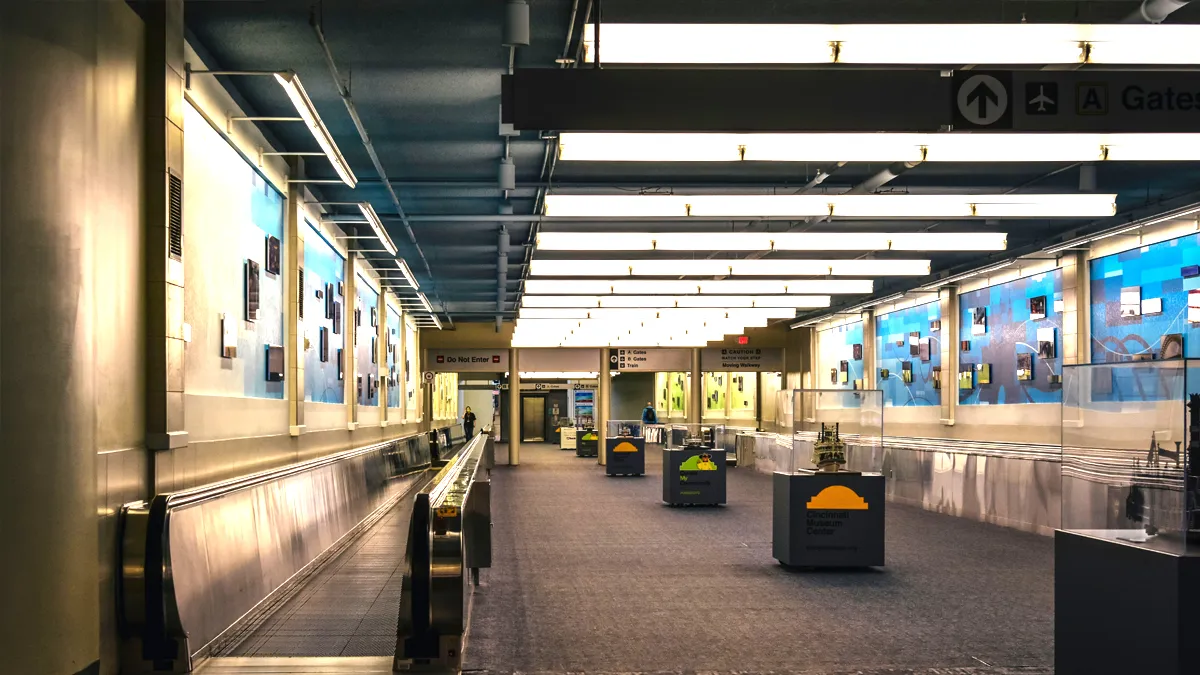
Museum and gallery lighting is one of the most demanding applications in the entire lighting industry. Unlike offices or warehouses, the primary goal is not to help people work—it is to help visitors see exhibits clearly, accurately, and safely, without accelerating the degradation of irreplaceable artifacts. A single mis-specified light fixture can fade a 200-year-old textile beyond recovery in less than two years.
This guide covers the technical requirements for museum-grade LED lighting: color rendering, UV and IR elimination, illuminance limits by object type, glare control, track systems, and how to specify fixtures that meet international museum standards (including IES LM-79, EN 13032, and CIE 157:2004).
Why Museum Lighting Is Different from Commercial Lighting
In a retail store, if a light source has a CRI of 70, the merchandise still sells. In a museum, a CRI of 70 means that red lake pigment on a Renaissance painting looks brown, and a collector’s sapphire appears navy blue. The consequences are both aesthetic and financial: inaccurate color reproduction directly reduces the perceived value of the exhibit.
Beyond color quality, three factors make museum lighting unique:
- Radiation damage: Ultraviolet (UV) and infrared (IR) radiation accelerate chemical decomposition in organic materials.
- Illuminance limits: Different artifact types have strict maximum lux limits (set by ICOM, IES, and national heritage agencies).
- Visual comfort: Visitors must see the artwork, not a bright reflection of themselves in the glass.
Color Rendering Index (CRI) and TM-30: The Minimum Standards
For museum applications, CRI alone is insufficient. CRI was developed in 1965 using only eight pastel-colored reference samples—none of which are saturated reds, blues, or greens commonly found in art.
| Système métrique | Minimum for Galleries | Recommended for Museums | Notes |
|---|---|---|---|
| CRI (Ra) | 90 | 95+ | CRI alone is not enough |
| R9 (Rouge saturé) | 50 | 90+ | Critical for artwork with red pigments |
| TM-30 Rf (Fidelity) | 90 | 95 | IES TM-30-18 standard |
| TM-30 Rg (Gamut) | 98–102 | 100±2 | Measures saturation shift |
| MacAdam Ellipse | 3-step | 2-step | Color consistency across fixtures |
R9 matters more than most specifiers realize. A fixture can have CRI 95 and still render deep red pigments incorrectly if R9 is low. For museum track lights and framers, always request the full color rendition report, not just the CRI number.
UV and IR: The Invisible Threat to Collections
Visible light fades dyes and pigments. UV radiation (wavelengths below 400 nm) and IR radiation (above 700 nm) cause different, more insidious damage:
- UV: Breaks molecular bonds in cellulose, linen, wool, silk, and paper. Causes “embrittlement” and yellowing. UV damage is cumulative and irreversible.
- IR (heat): Elevates local temperature on the artifact surface, accelerating chemical reactions and drying out organic materials.
LED sources have a fundamental advantage over halogen and incandescent lamps: well-designed LEDs produce essentially zero UV (the phosphor conversion process does not emit UV), and they emit very little IR compared to thermal sources.
However, not all LED fixtures are UV-free. Low-quality LEDs may use phosphors that re-emit small amounts of near-UV. Always request a spectroradiometric test report confirming <1 µW/lm UV content (per IES LM-79).
Illuminance Limits by Artifact Type
International guidelines (ICOM, Canadian Conservation Institute, and IES RP-30) specify maximum sustained illuminance levels for different materials. These limits represent the total illuminance on the artifact surface, including daylight and artificial light combined.
| Artifact / Material Type | Max Sustained Illuminance | Recommended Exposure |
|---|---|---|
| Very sensitive (paper, textiles, watercolors, dyes) | 50 lux | Rotate exhibits; limit to 3–6 months/year |
| Moderately sensitive (oil paintings, undyed leather, bone) | 150 lux | Can remain on display longer |
| Low sensitivity (stone, metal, glass, ceramics) | 300 lux | No strict limit; visual comfort is the constraint |
For LED fixtures in gallery spaces, dimming to 1% without color shift is essential. Many LED drivers exhibit “warm dim” or “amber shift” at low currents, which distorts artifact colors. Specify fixtures with deep dimming (0.1%–100%) with constant CCT.
Glare Control: The Science of Visual Comfort
Museum visitors should see the painting—not the reflection of the light source in the varnish, and not a bright “hot spot” on the canvas.
Two metrics matter:
- UGR (Unified Glare Rating): For museum spaces, target UGR <16 for viewing areas. This typically requires baffles, snoots, or honeycomb louvers on track lights.
- Cut-off angle: Track lights should have a cut-off angle of at least 30° from nadir. “Framing projectors” (framers) with four-leaf shutters allow precise beam shaping to avoid spilling light onto adjacent walls or glass.
For glass-covered exhibits, the angle between the light source and the viewer’s line of sight should be greater than 30° to avoid specular reflection. In practice, this means using narrow-beam (15°–25°) track lights positioned close to the vertical plane of the artwork, not recessed ceiling fixtures that are directly overhead.
Track Lighting Systems for Galleries and Temporary Exhibitions
Museums need flexibility. Exhibitions change every 3–6 months, and the lighting system must adapt without rewiring.
The industry-standard track types are:
- 3-circuit DALI track: Allows individually addressing up to 64 fixtures per track circuit. Enables scene setting, scheduled dimming, and integration with daylight sensors. This is the preferred system for new museum builds.
- Standard 3-wire track (phase-cut): Simpler and less expensive, but offers no digital control. Dimming is via trailing-edge phase dimmers, which can cause LED flicker at low levels.
- Low-voltage track (48V DC): Delivers power and control over a single conductor pair. Safer for public spaces and easier to install in heritage buildings where invasive ceiling work is restricted.
When specifying track fixtures for museums, prioritize:
- Framing shutters (framers): Allow precise beam shaping to match the artwork dimensions, eliminating stray light on adjacent walls.
- Hex louvers / Anti-glare accessories: Reduce off-axis glare for visitor comfort.
- Tool-free aiming: Museum staff frequently adjust beam angles; friction locks that require no tools reduce setup time.
Correlated Color Temperature (CCT) Selection by Exhibit Type
CCT affects how visitors feel in a gallery space, and it also affects color perception of the artifacts.
| TDC | Idéal pour | Effect on Artifacts |
|---|---|---|
| 2 700 K | Period rooms, warm-toned paintings, wood furniture | Enhances warm reds and browns; may make cool blues appear dull |
| 3 000 K | General galleries, mixed collections | Neutral; most commonly specified for modern museums |
| 3500K–4000K | Contemporary art, sculptures, stone/metal exhibits | Enhances cool colors; can make organic materials look “clinical” |
| Tunable white | Exhibition spaces with rotating collections | Allows adjusting CCT per exhibit without changing fixtures |
Tunable white is increasingly specified in new museum builds. A single gallery may host a warm-toned exhibition (e.g., Baroque paintings) for six months, then switch to contemporary video art (which looks better at 4000K). Tunable white track lights with DALI DT8 control allow this transition without rewiring or replacing fixtures.
Controls and Daylight Integration
Museums with skylights or windows face a unique challenge: daylight changes throughout the day, and the artificial lighting must compensate to maintain consistent illuminance on the artifacts (and prevent over-exposure).
A typical daylight-integrated control system for a museum gallery includes:
- Daylight sensors (photosensors): Mounted on the same plane as the artifacts, measuring total illuminance. The system dims artificial lights when daylight contributes sufficient lux, and raises output when clouds reduce natural light.
- Scheduled dimming: Automatically reduces light levels to 10% during non-public hours (e.g., 6 PM to 8 AM), extending artifact life by reducing total light exposure by ~60%.
- Scene control: DALI pushbuttons or a tablet UI allow curators to set “exhibition mode,” “cleaning mode” (higher light for maintenance), and “security mode” (motion-triggered).
Common Mistakes in Museum LED Specification
- Specifying CRI only: A fixture with CRI 97 but R9 = 20 will still distort red pigments. Always check the full spectral power distribution (SPD) chart.
- Ignoring binning: If 20 track lights are purchased from different color bins, the exhibition will have visible color inconsistencies across the room. Specify 2-step MacAdam ellipse binning.
- Overlooking flicker: Some LED drivers exhibit flicker at certain dimming levels (especially phase-cut dimmers). Visitors taking photos with smartphones will capture banding artifacts. Use DC or very-high-frequency (>2000 Hz) drivers.
- Using wide-beam floods on vertical surfaces: A 60° flood on a painting creates a bright circular spot on the wall around the artwork. Use 20°–30° narrow beams, or framers with shutters.
Retrofit Considerations: Replacing Halogen in Heritage Buildings
Many museums occupy heritage-listed buildings where ceiling modifications are prohibited. Retrofitting from halogen to LED in these spaces requires:
- Comparing lumen output, not wattage: A 50W halogen MR16 produces ~800 lumens. A 10W LED MR16 may produce 900+ lumens, which is too bright for a small gallery space. Choose lower-wattage LEDs and use the dimmer.
- Checking driver clearance: Heritage track systems often have shallow recessed housings. LED drivers may not fit. Use remote driver solutions or compact constant-current drivers.
- Maintaining the same beam angle: Halogen MR16s typically have a 36° or 60° beam. Replacing them with a 15° narrow LED changes the wall wash effect dramatically. Match the beam spread or use adjustable-beam LED lamps.
Checklist: Specifying LED Fixtures for Museum and Gallery Projects
| Specification Item | Target Value / Requirement |
|---|---|
| CRI (Ra) | ≥95 |
| R9 (Rouge saturé) | ≥90 |
| TM-30 Rf | ≥95 |
| UV content | <1 µW/lm (IES LM-79) |
| IR content | Negligible (<5% of total radiant flux) |
| Dimming range | 0.1%–100% (deep dimming) |
| MacAdam ellipse | 2-step or 3-step max |
| UGR (for viewing areas) | <16 |
| Flicker (percent flicker) | <1% at all dimming levels |
| Control protocol | DALI-2 or DALI DT8 (tunable) |
Selecting LED lighting for museums and galleries is a balance of color science, conservation physics, and visitor experience design. The upfront cost of museum-grade fixtures is higher than commercial-grade alternatives, but the cost of replacing a faded artifact is immeasurable. By specifying high-CRI, UV-free, deep-dimming LED systems with proper glare control, you protect both the collection and the institution’s reputation.