
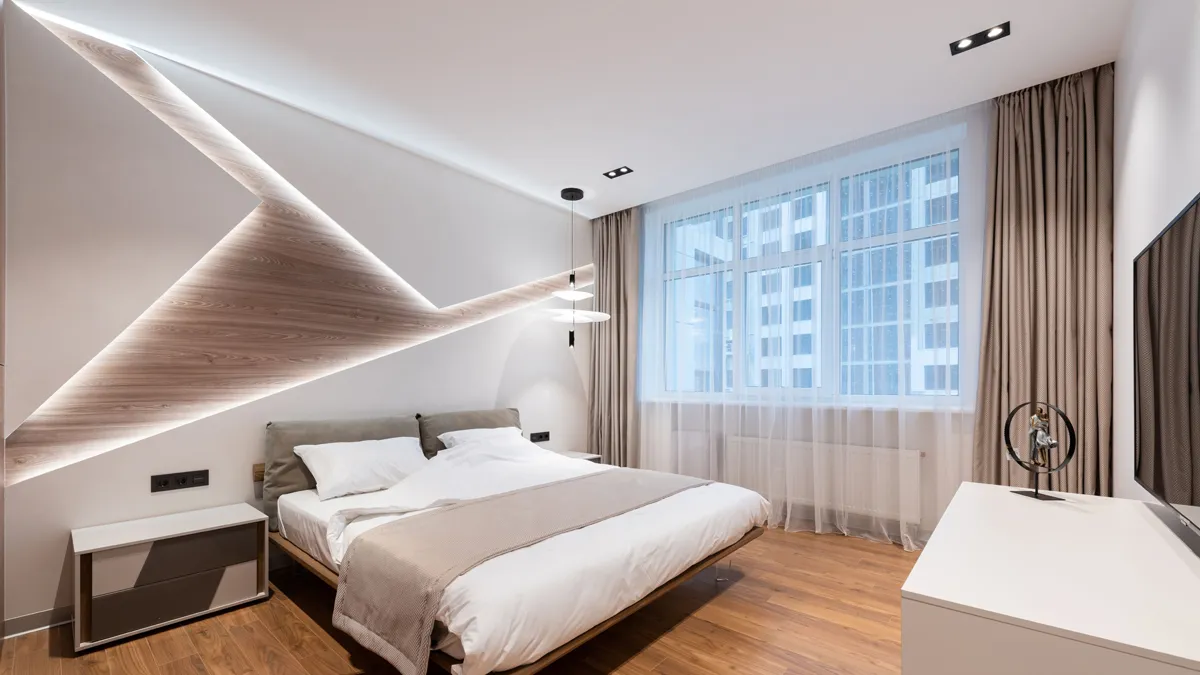
Hospitality lighting is the intersection of brand identity, guest psychology, and operational efficiency. The moment a guest enters a hotel lobby, the lighting determines whether they feel welcomed, impressed, or indifferent. In guest rooms, lighting affects sleep quality, productivity, and the guest’s likelihood to return. In restaurants and bars, lighting directly influences how long guests stay, how much they order, and how they rate the experience online.
This guide covers the design principles and technical specifications for hospitality LED lighting across all front-of-house and back-of-house areas: lobbies, guest rooms, restaurants, spas, fitness centers, and building exteriors.
The Three Layers of Hospitality Lighting Design
Professional hospitality lighting design uses three layers, applied consistently across all public spaces:
- Ambient (general) lighting: Provides uniform illumination for safe navigation. In lobbies, this is typically achieved with recessed downlights, cove lighting, or suspended architectural fixtures. Target 100–200 lux for lobbies; 50–100 lux for corridors.
- Task lighting: Focused light for specific activities. In guest rooms: desk lamps, vanity lighting, and bedside reading lights. In restaurants: task light at host stands and service stations.
- Accent lighting: Creates visual drama and draws attention to design features. In lobbies: wall-wash grazing on stone cladding, spotlighting on floral arrangements or art. In guest rooms: accent light on headboard features or artwork.
The ratio of these three layers determines the “mood” of the space. A luxury hotel lobby might use 20% ambient, 10% task, and 70% accent. A budget hotel prioritizes uniform ambient lighting for perceived cleanliness and safety.
Lobby and Reception Lighting: Creating the First Impression
The lobby is the hotel’s “living room.” Lighting design here must achieve two contradictory goals: make a dramatic impression while providing comfortable vision for check-in tasks.
Key design parameters:
| Paramètres | Recommended Value | Notes |
|---|---|---|
| Average illuminance | 150 à 300 lux | Higher for check-in counters; lower for lounge areas |
| TDC | 2700K–3000K | Warmer CCTs feel more “luxury” |
| CRI | ≥90 | Critical for guest appearance (skin tones) and interior finishes |
| Wall illuminance ratio | 0.5–0.7 of floor illuminance | Well-lit walls make spaces feel larger |
Decorative fixtures as brand statements: Many luxury hotels use custom chandeliers or pendant arrays in the lobby. When specifying decorative fixtures with integrated LEDs, verify that the LED modules are replaceable (standard GX53 or custom modules with available spares for 10+ years). Replacing a custom chandelier’s LEDs should not require taking down the entire fixture.
Guest Room Lighting: Balancing Comfort and Function
Guest room lighting is the most personal lighting experience in hospitality. A poorly lit guest room leads to negative reviews mentioning “dark,” “gloomy,” or “couldn’t see to work.” A well-lit room feels premium even if the furniture is modest.
Bedside and Reading Lights
Bedside lighting must provide adequate reading light (at least 150 lux at the pillow) without spilling light onto the partner’s side of the bed. Adjustable beam wall washers or swing-arm reading lights are the industry standard. Avoid bare downlights positioned directly over the pillow—they cause glare and make reading uncomfortable.
Vanity and Bathroom Lighting
The vanity area is where guests spend the most time evaluating themselves. Poor vanity lighting creates shadows under the eyes and chin, making guests look tired.
The correct approach: cross-illumination from the sides, not from above. Wall sconces mounted at 1500–1600 mm above finished floor (AFF), centered on the mirror, provide even facial illumination. The CRI requirement here is particularly strict: skin tones must look natural, not washed out or overly ruddy. Specify CRI ≥90, and request the fixture manufacturer’s spectral distribution chart.
Desk and Work Area
Business travelers need 300–500 lux on the desk surface. A dedicated desk lamp with adjustable arm and integrated LED is preferred over a fixed recessed downlight, which may create reflections on laptop screens.
Scene Control (the “Do Not Disturb” of Lighting)
Modern guest rooms use scene controllers (typically a tablet or wall keypad) with preset lighting scenes:
- Welcome scene: 70% ambient + accent on, creating an inviting first impression when the guest enters.
- Work scene: Desk light at 100%, bedside at 30%, ambient dimmed.
- Relax scene: Ambient at 30%, accent on, bedside at 50%.
- Sleep scene: All lights off except a low-level pathway light (≤1 lux) to the bathroom.
- TV scene: Ambient off, accent on at 20%, eliminating screen reflections.
These scenes are typically implemented with DALI or 0-10V dimming systems integrated into the hotel’s room management system (RMS).
Restaurant and Bar Lighting: Driving Revenue through Atmosphere
Research in environmental psychology consistently shows that lighting levels influence dining duration and spending. Dim lighting (50–100 lux average) encourages guests to linger, order another round, and perceive the food as higher quality. Bright lighting (>300 lux) speeds up table turnover but reduces average check size.
| Venue Type | Average Illuminance | TDC | Design Goal |
|---|---|---|---|
| Fine dining | 50–100 lux | 2 700 K | Intimacy, linger time |
| Casual dining | 150 à 200 lux | 2700K–3000K | Comfortable, social |
| Hotel bar / lounge | 80–150 lux | 2400K–2700K | Evening relaxation |
| Breakfast buffet | 300-500 lux | 3000K–3500K | Energy, food appearance |
Food appearance and CCT: Warm CCT (2700K) makes red meat and wood-fired dishes look appetizing. Cool CCT (3500K+) makes salads, seafood, and pastries look fresher. If a restaurant serves both, consider tunable white or separate lighting zones for different serving areas.
Table-level glare control: Guests should not see the light source when seated. Use baffled downlights, wall washers, or pendant fixtures with deep recessed sources. The cutoff angle should be at least 45° from the horizontal plane at seated eye level (approximately 1100 mm).
Corridor and Circulation Lighting: Safety and Wayfinding
Corridors are the most energy-intensive space in a hotel by operating hours—lights are on 24/7. Two strategies reduce energy without compromising safety:
- Occupancy-based dimming: Corridor lights operate at 10–20% baseline and ramp to 80–100% when the PIR sensor detects motion. This reduces energy consumption by 60–80% compared to constant-full-output.
- Récupération de la lumière du jour : For corridors with windows or skylights, photosensors dim artificial lights when daylight provides >50 lux on the floor.
Illuminance targets for corridors:
- General illumination: 50–100 lux
- At doorways (key insertion area): 100–150 lux
- Emergency lighting (standby): 1 lux minimum (per ISO 30061 / EN 50172)
Exterior and Landscape Lighting: The Curbside Appeal
A hotel’s exterior lighting is its billboard. Facade lighting, landscape lighting, and porte-cochère illumination must work together to create a coherent nighttime identity.
Common exterior lighting techniques for hospitality:
- Wall grazing: Linear LED fixtures positioned close to the facade wall, grazing the surface to reveal texture (stone, brick, or architectural panel). Use 3000K for warm stone; 4000K for modern glass facades.
- Floodlighting: Wide-beam projectors illuminating the entire facade. Position floodlights to avoid light trespass into guest room windows (use back-light shields and precise aiming).
- Pathway bollards: Low-level lighting along driveways and walkways. Bollard spacing: 3–5 m for uniform illumination. Luminaire height: 600–1000 mm.
- Tree uplighting: Narrow-beam (10°–15°) fixtures aimed at tree canopies. Use 3000K for deciduous trees; 2700K for evergreens to simulate moonlight.
Dark-sky compliance: Hospitality projects in environmentally sensitive areas (resorts near coastlines, mountain lodges) may be required to comply with dark-sky ordinance limits on uplight and light trespass. Use full-cutoff fixtures and aim all exterior lights below 90° (horizontal plane).
Wellness Areas: Spa, Gym, and Pool
Wellness spaces have specific lighting requirements driven by the activities performed there:
- Spa treatment rooms: Very low illuminance (20–50 lux) with warm CCT (2700K). Dimmable to 1% for treatments involving rest or meditation. No glare sources in the client’s field of view.
- Fitness center: Higher illuminance (300–500 lux) to promote energy and safety. CCT: 3500K–4000K. Avoid shadows on equipment where guests could trip.
- Swimming pool / indoor pool: IP68-rated underwater fixtures with low-voltage (12V or 24V) DC supply. Avoid aiming lights at the water surface where they create glare for swimmers. Pool water itself acts as a light guide—position underwater fixtures to create even illumination without hot spots.
Energy Efficiency and ESG Compliance in Hospitality
Hotels operate lighting 16–24 hours per day. A 200-room hotel can spend $30,000–$80,000 annually on lighting energy alone. LED upgrades typically achieve 50–70% energy savings, with payback periods of 1.5–3 years.
Beyond energy, hospitality brands are increasingly evaluated on ESG criteria by investors and corporate clients. Lighting contributes to ESG scores through:
- Energy Star or DLC-certified fixtures: Verifiable energy performance data.
- Dimming and controls: Reduces energy and extends lamp life. DALI-2 certified control systems provide audit trails of energy consumption.
- Circular design: Specify fixtures with replaceable LED modules and drivers. A hotel lighting system should be serviceable for 10–15 years without full replacement.
Retrofit Considerations for Operating Hotels
Retrofitting an operating hotel is a logistics challenge: guest rooms must remain bookable, and public spaces must remain usable during evening peak hours.
Best practices for hospitality retrofits:
- Floor-by-floor or zone-by-zone scheduling: Never take all guest room floors offline simultaneously. Stage the retrofit in blocks of 10–20 rooms.
- Plug-and-play retrofit kits: For guest room downlights, use LED retrofit kits that install into existing ceiling cutouts without patching or repainting. This reduces room downtime from 4 hours to 30 minutes.
- Mock-up rooms: Before committing to a full-property retrofit, install the new lighting in one showroom and one standard guest room. Live with it for two weeks and collect guest feedback on comfort and appearance.
- Staff training: New dimming and scene control systems require front-desk and housekeeping staff training. Include a 2-hour training session and quick-reference cards in each staff room.
Checklist: Hospitality LED Lighting Specification
| Zone | Illuminance (lux) | TDC | CRI | Special Requirements |
|---|---|---|---|---|
| Lobby / Reception | 150–300 | 2700K–3000K | ≥90 | Decorative fixtures, glare control |
| Guest room (general) | 100–200 | 2700K–3000K | ≥90 | Scene control, bedside reading |
| Guest room (vanity) | 300–500 | 2700K–3000K | ≥90 | Cross-illumination, no shadows |
| Guest room (desk) | 300–500 | 3000K–3500K | ≥80 | Adjustable task light |
| Restaurant (fine dining) | 50–100 | 2 700 K | ≥90 | Dimming to 5%, table glare control |
| Corridor | 50–100 | 3 000 K | ≥80 | Occupancy dimming, 24/7 operation |
| Fitness center | 300–500 | 3500K–4000K | ≥80 | Uniformity, safety (no shadows) |
| Spa treatment room | 20–50 | 2 700 K | ≥90 | Deep dimming (<1%), no glare |
Great hospitality lighting is invisible when done well—guests feel comfortable without noticing why. When done poorly, it becomes the subject of negative reviews. By layering ambient, task, and accent lighting; specifying high-CRI LEDs with warm CCT; and integrating intelligent dimming controls, you create spaces that support the hotel’s brand promise and drive both guest satisfaction and operational efficiency.