
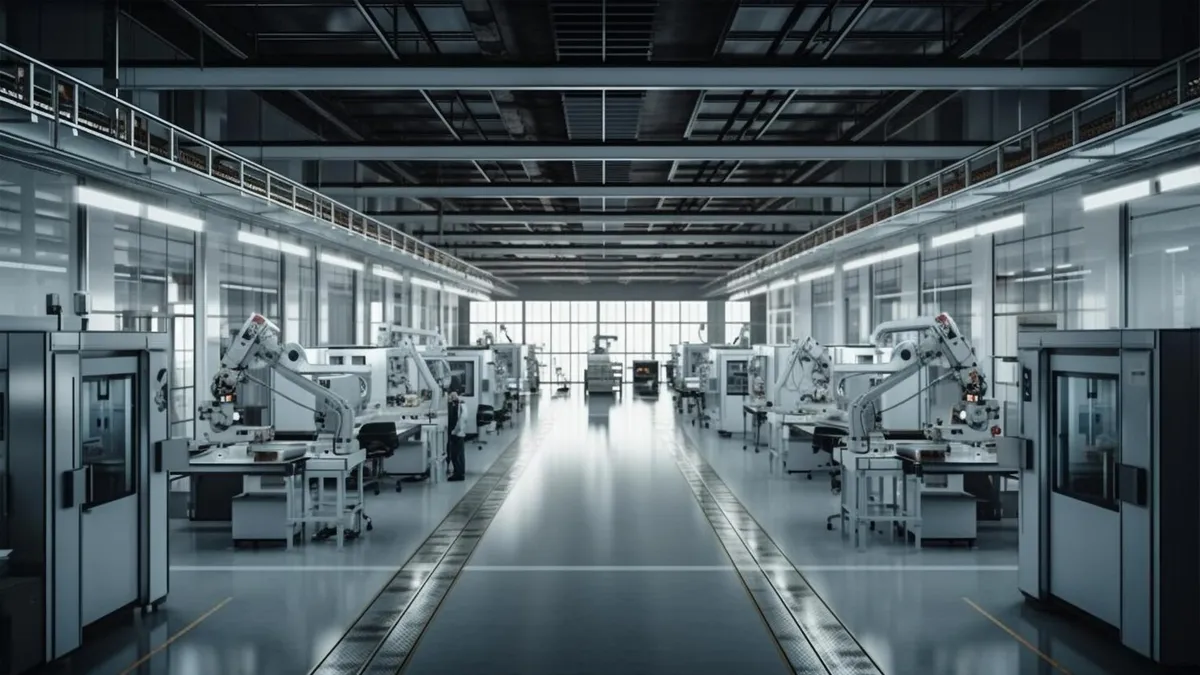
Industrial facilities increasingly operate 24 hours a day. Semiconductor fabs, automotive plants, food processing, logistics centers — all run multiple shifts. But human biology doesn’t adapt well to night work. Shift workers experience circadian misalignment, sleep disorders, reduced alertness, and higher accident rates.
Tunable white LED lighting is emerging as a tool to mitigate these effects. By adjusting color temperature (CCT) and intensity throughout the day, industrial lighting can support workers’ circadian rhythms even during night shifts.
This guide covers what facility managers need to know about specifying, installing, and operating human-centric LED lighting in industrial environments.
What Is Tunable White LED Lighting?
Tunable white (also called adjustable CCT) LED fixtures can change their color temperature dynamically — typically from warm white (2700K) to cool white (6500K) or beyond. This is achieved by mixing two (or more) LED channels:
- Dual-channel: Warm white (2700–3000K) + Cool white (5000–6500K). Most common for industrial applications.
- Three-channel: Adds a dedicated amber or red channel for enhanced circadian stimulus in the evening/night.
- Full-spectrum: Multiple LED wavelengths mimic natural daylight spectral power distribution. Highest cost, best circadian effect.
The fixture adjusts the mix between channels based on a control signal (0–10V, DALI, wireless) to achieve the target CCT.
Why Industrial Facilities Need Human-Centric Lighting
The Shift Work Problem
Night shift workers face several well-documented problems:
- Circadian misalignment: Body clock expects darkness at night. Exposure to light (especially blue-rich light) at night suppresses melatonin and disrupts sleep-wake cycles.
- Reduced alertness: Core body temperature and cortisol levels drop at night. Workers are physiologically less alert, increasing accident risk.
- Sleep disorders: Shift workers have 2–5× higher rates of chronic sleep disorders compared to day workers.
- Higher accident rates: Night shifts have 15–30% higher accident rates in industrial settings, partly due to reduced alertness.
How Tunable White Lighting Helps
Human-centric lighting doesn’t “fix” shift work — but it can reduce the biological impact:
- Day shifts: Cool white (5000–6500K) promotes alertness and matches natural daylight, supporting concentration and visual acuity for detailed tasks.
- Evening shifts: Gradually transition from cool to neutral white (3500–4000K) as the shift progresses, signaling to the body that sunset is approaching.
- Night shifts (start): Cool white (5000K+) during the first 4–6 hours to maintain alertness during the circadian low point.
- Night shifts (end): Warm white (2700–3000K) for the last 2 hours, reducing circadian disruption when workers go home to sleep.
Research shows properly timed tunable white lighting can improve alertness by 10–20%, reduce sleep disruption, and decrease accident rates in shift work environments.
Circadian Stimulus (CS) and Melanopic Ratios
Not all “white” light affects circadian rhythms equally. The ipRGC (intrinsically photosensitive retinal ganglion cells) in the human eye are most sensitive to short-wavelength (blue) light around 480 nm.
Key Metrics
- Melanopic EDI (Equivalent Daylight Illuminance): The effective circadian illuminance, weighted by the ipRGC spectral sensitivity curve. Measured in lux (circadian lux).
- Circadian Stimulus (CS): A 0–1 scale of circadian effect. CS >0.3 is considered “high stimulus” (alertness-promoting). CS <0.1 is “low stimulus” (suitable for evening/night to minimize disruption).
- Melanopic Ratio: Ratio of melanopic lux to photopic lux. Higher ratios = more circadian impact.
For industrial human-centric lighting design, specify fixtures with published melanopic EDI data at different CCT settings. A 6500K setting might have a melanopic ratio of 0.8–1.0, while 2700K might be 0.4–0.5.
Specifying Tunable White LEDs for Industrial Environments
Fixture Requirements
- CCT range: Minimum 2700K–5000K. Preferred 2700K–6500K for full flexibility.
- Dimming range: 1%–100% (0.1% preferred for nighttime warm-white operation).
- Control protocol: DALI-2 DT8 (color control) is the emerging standard. 0–10V is simpler but offers less granular control.
- Flicker: <1% flicker at all CCT and dimming levels. Fluctuating light during night shifts increases eye strain and fatigue.
- Industrial rating: IP54 minimum for general industrial use. IP65+ for washdown or dusty environments. IK08+ impact rating.
- Lifetime: L70 >100,000 hours. Tunable fixtures have more complex driver electronics — verify reliability data.
Control System Architecture
Tunable white requires a control system to manage CCT transitions. Options:
| Approach | Pros | Cons | Best For |
|---|---|---|---|
| Standalone timeclock | Simple, low cost, no network needed | Limited flexibility, no manual override from central location | Small facilities, single-shift operations |
| DALI-2 DT8 system | Granular control per zone, integration with BMS | Higher cost, requires DALI wiring or gateway | Medium–large facilities, multi-shift operations |
| Wireless mesh (Zigbee, Thread) | No control wiring needed, easy reconfiguration | Wireless reliability concerns in industrial RF environments | Retrofit projects, legacy facilities |
| BMS integration (BACnet, Modbus) | Centralized control, integration with HVAC and security | Highest cost, requires BMS infrastructure | Large campuses, corporate-standard facilities |
Lighting Design for Human-Centric Industrial Spaces
Mounting Height and Beam Angle
Tunable white LEDs for industrial use are available in the same form factors as standard industrial LEDs — high-bay, low-bay, linear, and trunking systems. The same layout principles apply: mount high enough for uniform illumination, select beam angle based on ceiling height.
However, tunable fixtures often have slightly lower efficacy (lm/W) than fixed-CCT fixtures — the additional LED channels and more complex driver reduce efficiency by 5–15%. Factor this into energy calculations.
Task-Specific Considerations
- Assembly lines: Higher CCT (5000K) during day shifts for visual acuity on small parts. Tunable allows matching to natural daylight through windows (if present).
- Quality control/inspection: CRI >85 required regardless of CCT. Some QC tasks benefit from higher CCT (better contrast), others from lower CCT (reduced glare on reflective surfaces).
- Warehouse picking: Cool white (5000K) improves alertness during night shifts. Ensure UGR <19 for areas with computer terminals.
- Break rooms: Warm white (2700–3000K) exclusively. This is where workers rest and prepare for sleep (especially important for night-shift workers who sleep during the day).
Implementation: Retrofit vs. New Construction
Retrofit Challenges
Retrofitting existing industrial LED fixtures to tunable white is rarely cost-effective. The existing fixtures lack the dual-channel LED boards and compatible drivers. Full fixture replacement is usually required.
Control wiring is the main retrofit challenge. DALI-2 DT8 requires additional control wires to each fixture. Wireless control (Zigbee, Thread) avoids new wiring but adds potential reliability concerns in electrically noisy industrial environments.
New Construction
Specify tunable white from the start. The cost premium over fixed-CCT LEDs has narrowed to 15–30% (was 50–100% five years ago). Control wiring (DALI or 0–10V) should be included in electrical plans even if the control system is phased in later.
Recommended CCT Schedules for Industrial Shifts
| Shift | Time | Start CCT | End CCT | Anmerkungen |
|---|---|---|---|---|
| Day shift | 06:00–14:00 | 5000K | 5000K | Match natural daylight. Maximize alertness. |
| Swing/evening | 14:00–22:00 | 5000K | 3500K | Gradual transition. Prepare body for sleep after shift. |
| Night (early) | 22:00–02:00 | 6500K | 5000K | High CCT maintains alertness during circadian low. |
| Night (late) | 02:00–06:00 | 5000K | 2700K | Transition to warm white. Reduce circadian disruption post-shift. |
These are starting points. Optimal schedules vary by facility, geographic location (daylight patterns), and workforce preferences. Program the control system for flexibility — allow supervisors to override the schedule when needed (e.g., during critical production runs).
Cost-Benefit Analysis
Cost Premium
- Tunable white industrial LEDs: 15–30% cost premium over fixed-CCT equivalents
- Control system (DALI-2): $30–$80 per fixture additional cost
- Installation: 10–20% additional labor for control wiring
Quantified Benefits
- Accident reduction: 10–25% reduction in night-shift accidents (varies by industry). For a facility with $500K annual accident-related costs, 15% reduction = $75K/year savings.
- Productivity: 2–5% productivity improvement from better alertness. For a 100-worker facility with $50K average labor cost, 3% = $150K/year.
- Absenteeism: 8–15% reduction in sick days among shift workers. 100 workers × 2 fewer sick days × $200/day = $40K/year.
- Recruitment/retention: Difficult to quantify, but “human-centric workplace” is a differentiating factor in tight labor markets.
Payback period: 2–5 years for typical industrial facilities with significant shift operations.
Standards and Certifications
- WELL Building Standard (Feature L03): Circadian lighting design. Requires melanopic EDI >200 lux during daytime hours for occupied spaces.
- UL 24480 (Circadian Metric): Standard for measuring and reporting circadian stimulus of lighting products.
- IEC 62471 (Photobiological Safety): Ensures tunable white LEDs don’t produce hazardous blue light exposure at close ranges.
- DALI-2 Part 209 (Color Control): Standardized control protocol for tunable white fixtures. Ensures interoperability between fixture and control system vendors.
Fahrplan für die Umsetzung
- Phase 1 — Audit: Document current shifts, accident rates, worker complaints. Identify pilot areas (one production line or department).
- Phase 2 — Pilot: Install tunable white in pilot area. Run for 3–6 months. Survey workers, track accident rates and productivity metrics.
- Phase 3 — Refine: Adjust CCT schedules based on pilot feedback. Some workers prefer different schedules — build flexibility into the control system.
- Phase 4 — Rollout: Expand to full facility. Train facilities team on control system operation and troubleshooting.
- Phase 5 — Monitor: Annual review of metrics. Adjust schedules seasonally if needed (daylight hours change throughout the year).
Common Pitfalls to Avoid
- “Set and forget”: Tunable lighting only works if the CCT actually changes. Assign responsibility for schedule management and periodic review.
- Ignoring break rooms: Workers spend 30+ minutes per shift in break rooms. Warm white lighting here is critical for day-sleep preparation (night shift workers).
- Over-automation: Give shift supervisors manual override capability. Production emergencies sometimes require deviation from the lighting schedule.
- Skimping on control system: Cheap timeclocks limit flexibility. Invest in a proper DALI-2 or wireless system that allows zone-based scheduling.
- No worker input: Survey workers before and after installation. Their feedback is the most valuable data for optimizing schedules.
Schlussfolgerung
Tunable white LED lighting is not a magic solution for shift work challenges — but it is a proven tool to reduce circadian disruption, improve alertness, and create a more supportive environment for 24/7 industrial operations. The technology has matured, costs have decreased, and standards (WELL, DALI-2 DT8) provide clear guidance for specification.
For facilities with significant night-shift operations, the ROI extends beyond energy savings to measurable improvements in safety, productivity, and worker wellbeing. Start with a pilot program, measure the results, and scale based on evidence.