
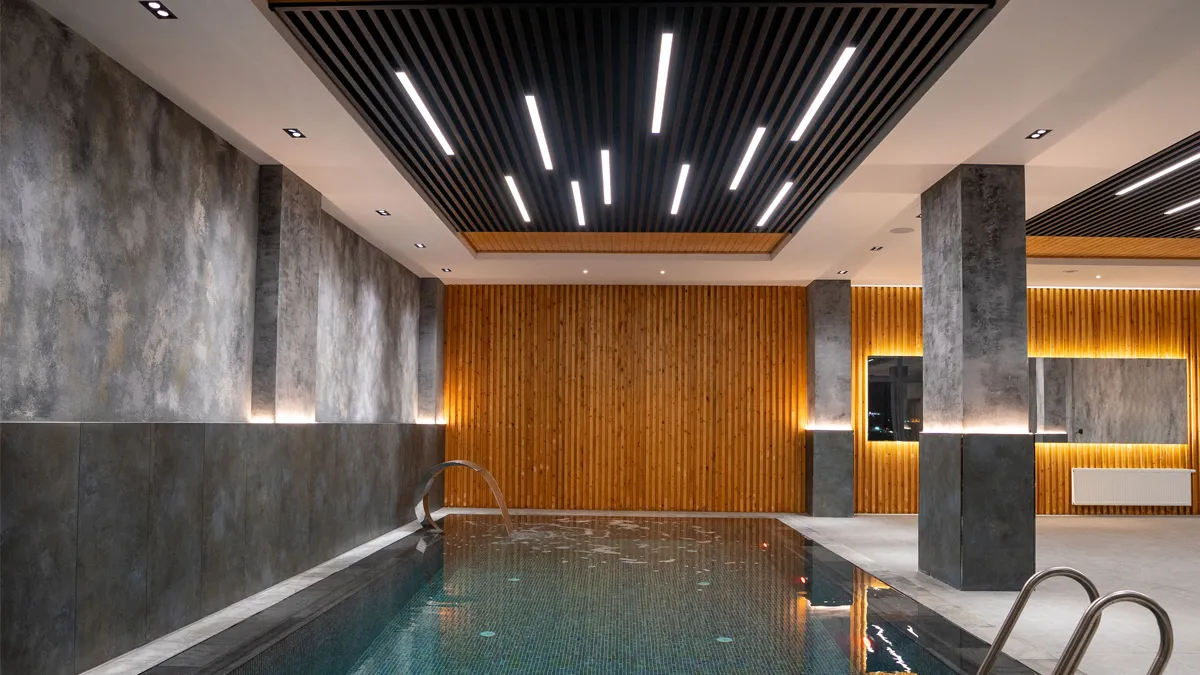
Why Residential LED Deserves More Than a Trip to the Hardware Store
The consumer LED market is flooded with cheap bulbs that overpromise and underdeliver. Flicker, poor color rendering, premature failure, and incompatible dimming are the most common complaints. This guide explains the specifications that actually matter, so you can choose residential LED products that look good, last long, and work with your existing switches and dimmers.
Color Temperature (CCT): Matching LED to Room Function
CCT is measured in Kelvin (K). Lower numbers = warmer (more yellow/red). Higher numbers = cooler (more blue). The right CCT is not about “which is better” — it’s about which supports the room’s function.
| مجموعة CCT | Perceived Color | الأفضل لـ |
|---|---|---|
| 2700 كيلو | أبيض دافئ | Bedrooms, living rooms, dining areas |
| 3000 كيلو | Soft white | Kitchens, hallways, residential bathrooms |
| 3500 كلفن – 4000 كلفن | أبيض محايد | Home offices, garages, task areas |
| 5000K+ | Cool/daylight | Not recommended for residential (too clinical) |
Pro tip: Mixing CCTs within the same room creates a disjointed feel. Stick to one CCT per room, or use tunable-white products if you want flexibility.
Color Rendering Index (CRI): Why 80 Is the Bare Minimum
CRI measures how accurately a light source reveals colors compared to natural daylight. Scale: 0–100. In residential settings, low CRI makes wood floors look dull, food unappetizing, and skin tones unnatural.
- CRI 80–89: Acceptable for hallways, storage, exterior. Not ideal for living spaces.
- CRI 90+: Recommended for kitchens, bathrooms, dressing areas, and anywhere you want colors to look natural.
- R9 (Saturated Red): Many “CRI 80” bulbs have terrible R9 values (even negative). Look for products that disclose R9 separately.
Dimming Compatibility: The #1 Source of Residential LED Complaints
Not all LED bulbs work with all dimmer switches. The symptom: flickering, “pop-on” at ~30% brightness, or buzzing. The cause: mismatch between the bulb’s driver topology and the dimmer’s control method.
Dimmer Types and LED Compatibility
| Dimmer Type | How It Works | LED Compatible? |
|---|---|---|
| Triac (leading-edge) | Cuts AC sine wave | Only with “dimmable” LED labeled Triac-compatible |
| ELV (trailing-edge) | More precise cut | Better LED compatibility; preferred for low-voltage |
| 0-10V | Separate control wires | Requires fixture with 0-10V driver (rare in residential) |
| DALI / Smart | Digital command | Best performance; requires smart system |
Before buying: Check your existing dimmer model against the LED bulb manufacturer’s compatibility list. It takes 2 minutes and prevents 2 hours of troubleshooting.
Flicker: The Invisible Problem
LED flicker is caused by insufficient driver filtering of the AC ripple. It’s invisible to some people but causes headaches, eye strain, and fatigue in others — especially children and people with photosensitivity.
How to Detect and Avoid Flicker
- Use your smartphone camera: point it at the lit bulb. If you see dark bands scrolling, that’s flicker.
- Look for “flicker-free” or “IEEE 1789 compliant” in the specification sheet.
- PWM (pulse-width modulation) dimming below 1000 Hz is a red flag. Ask for >3000 Hz or DC-dimming.
Bulb Types and Form Factors: What the Labels Mean
E26/E27 (Edison Screw)
The standard residential base in North America (E26) and Europe/Asia (E27). When replacing incandescents, match the lumen output, not the wattage. A 60W incandescent replacement is typically 800 lumens at 8–10W LED.
GU10 (Twist-and-Lock)
Common for recessed cans, track lighting, and accent lighting. GU10 LED retrofit bulbs are widely available, but optical quality varies enormously. For accent lighting, prioritize beam angle and center-beam candela over total lumens.
Integrated LED Fixtures
Many modern residential fixtures have non-replaceable LEDs. The advantage: better thermal management and optical design. The risk: if the LED fails, you replace the whole fixture. For integrated fixtures, verify the rated L70 lifetime (should be >50,000 hours) and whether the driver is accessible for service.
Lumens per Watt: Efficiency Without the Marketing Hype
| Product Class | Typical Efficacy (lm/W) | Assessment |
|---|---|---|
| Premium residential LED bulb | 90–120 | جيد |
| High-end integrated fixture | 100–140 | Very good |
| Industrial-grade LED (for reference) | 130–180 | Excellent (overkill for homes) |
Don’t chase the highest lm/W at the expense of CRI and dimming quality. A 90-lm/W bulb with CRI 95 and flicker-free dimming is a better residential product than a 140-lm/W bulb with CRI 75 and visible flicker.
Smart Home Integration: When to Go Beyond “Just a Bulb”
Residential LED has converged with smart home platforms. The main options:
- Wi-Fi bulbs: Easiest to set up. Disadvantage: consumes an IP address per bulb and depends on Wi-Fi range.
- Zigbee / Thread bulbs: Require a hub but form a mesh network. More reliable for whole-home coverage.
- Matter-compatible bulbs: The emerging standard. Buy these if you want future-proof compatibility across Apple Home, Google Home, and Amazon Alexa.
Exterior and Landscape Residential LED
Exterior residential LED has different priorities: durability, dark-sky compliance, and safety. Key considerations:
- Cutoff angle: Use full-cutoff fixtures to avoid light trespass to neighbors and sky glow.
- CCT for exteriors: 2700K–3000K only. Cool-white exteriors look institutional and waste more light into the sky.
- Motion sensors: Pair exterior LEDs with motion sensors for security and energy savings. Look for “dusk-to-dawn” photocontrol integration.
- Low-voltage landscape: 12V or 24V systems are safer for DIY installation. Use LED with proper IP65+ rating for in-ground fixtures.
Quick Specification Checklist for Any Residential LED Purchase
- ✅ CCT appropriate for room function (2700K–3000K for living spaces)
- ✅ CRI > 90 for living areas; > 80 acceptable for utility
- ✅ Dimmable + verified compatible with existing dimmer (if applicable)
- ✅ Flicker-free (test with smartphone camera)
- ✅ ENERGY STAR or equivalent certification
- ✅ Minimum 3-year warranty from a traceable manufacturer
- ✅ L70 lifetime > 25,000 hours (preferably > 50,000)
الخلاصة
Residential LED lighting has matured past the “any LED is better than incandescent” phase. Today, the difference between a good and bad LED purchase comes down to color quality, dimming compatibility, and flicker control. Use the specifications in this guide to evaluate products critically — and don’t be afraid to pay a small premium for measurable quality differences that you’ll notice every evening.