
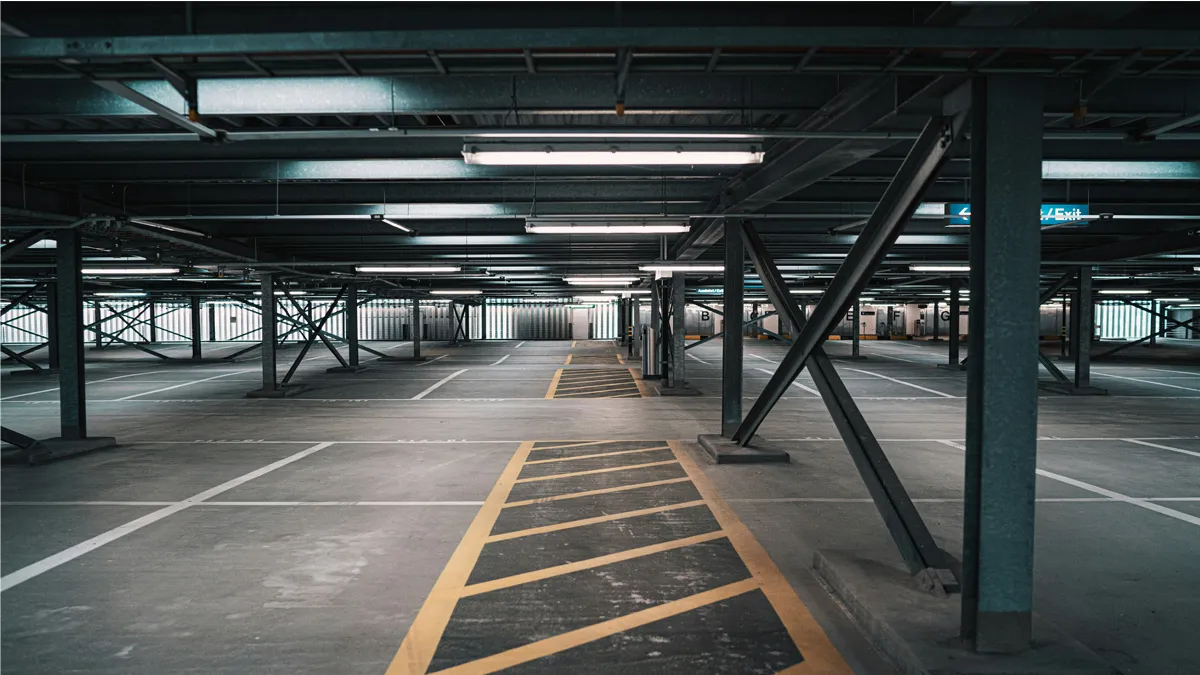
A parking garage at 2 a.m. with patchy, flickering fluorescent tubes does two things: it makes drivers nervous and it tells criminals exactly where the cameras can’t see. Lighting in parking structures isn’t about aesthetics. It’s about safety, liability, and operational cost — in that order.
Most facility managers know their garage lighting is bad. What they don’t know is that upgrading to properly specified LED fixtures typically cuts energy use by 60 to 75 percent while eliminating the dark zones that make parking structures feel unsafe. The math works. The trick is specifying it correctly.
Why Parking Garage Lighting Is Different
Parking garages create a lighting problem that doesn’t exist in warehouses or offices: the space has a ceiling but no walls. Daylight pours in at the perimeter while the core stays dark. Cars move through constantly, headlights sweep across surfaces, and shadows shift by the minute. Add exhaust fumes, temperature swings from -20°F to 110°F depending on the climate, and concrete dust from tire wear — and you have an environment that eats standard commercial fixtures for breakfast.
The Illuminating Engineering Society addresses this in IES RP-20, the recommended practice for parking facility lighting. RP-20 breaks parking structures into zones and assigns each a minimum maintained illuminance. Not initial illuminance — maintained. That distinction matters because fluorescent and HID fixtures lose 30 to 40 percent of their output within the first year. LEDs, by contrast, retain 90-plus percent of initial lumens deep into their rated life.
IES RP-20 Illuminance Recommendations at a Glance
| Zone | Min Horizontal Illuminance | Uniformity Ratio (avg:min) | Notes |
|---|---|---|---|
| Parking bays (general) | 5 fc (50 lux) | 3:1 max | Measured at floor level |
| Active traffic lanes | 5 fc (50 lux) | 3:1 max | Along lane centerline |
| Ramps (daytime) | 5 fc (50 lux) | 3:1 max | Higher if transition from bright exterior |
| Ramps (nighttime) | 5 fc (50 lux) | 3:1 max | Same base but easier to maintain |
| Entrances/exits (daytime) | 50-100 fc | 3:1 max | Transition zone to prevent black hole effect |
| Entrances/exits (nighttime) | 5-10 fc | 3:1 max | Reduced to avoid glare into street |
| Stairwells | 10 fc (100 lux) | 3:1 max | Vertical illuminance at treads |
| Elevator lobbies | 10 fc (100 lux) | 3:1 max | At floor level |
| Cashier/payment areas | 20-50 fc | 3:1 max | Higher for transaction accuracy |
The black hole effect during daytime is a common failure point. A driver enters from bright sunlight into a dark garage entrance. If the ramp’s first 50 feet aren’t lit to at least 50 fc, the driver’s eyes can’t adapt fast enough. That’s where accidents happen — and where lawsuits start.
Fixture Types: What Works Where
Not every parking garage zone needs the same fixture. Mixing fixture types by zone improves both lighting quality and installation cost.
Linear LED Vapor-Tight Fixtures
For open parking decks and drive aisles, linear vapor-tight LED fixtures (typically 4-foot or 8-foot) mounted to the ceiling or suspended from cable systems provide broad, even coverage. Look for fixtures rated IP65 or higher — they’ll shrug off the moisture, dust, and occasional car-wash overspray that kill standard shop lights. A color temperature of 4000K to 5000K keeps the space feeling crisp without the cold blue of 6500K warehouse lighting.
Low-Profile Surface-Mount Canopies
Under low ceilings — common in underground and below-grade garages where clearance is 8 feet or less — low-profile canopy lights with wide-distribution optics avoid hot spots directly under the fixture. Narrow-beam fixtures in tight spaces create pools of bright light surrounded by darkness, which is worse for perception of safety than uniformly moderate light.
Wall Packs for Perimeter and Entrances
Wall-mounted LED fixtures at entry/exit points serve double duty: they illuminate the transition zone for drivers and light up pedestrian pathways. Full-cutoff optics matter here. A wall pack that sprays light upward wastes energy and creates glare for neighboring properties. Look for Dark Sky compliant models with forward-throw distributions.
Sensor-Integrated Fixtures
Modern LED garage fixtures increasingly come with built-in microwave or PIR occupancy sensors. In a parking structure, these sensors dim fixtures to 20 percent when no motion is detected and ramp to full output in under 0.5 seconds when a vehicle or pedestrian enters the zone. The energy savings from this alone can push the payback period under two years in facilities with low nighttime occupancy.
Design Considerations That Most Spec Sheets Miss
Vertical Illuminance — The Forgotten Metric
Horizontal illuminance (light hitting the floor) is easy to measure, so everyone measures it. But in a parking garage, vertical illuminance — light hitting faces, license plates, and vehicle sides — is what makes people feel safe and what lets security cameras do their job. A person standing between two cars in a garage lit to a perfect 5 fc horizontal can still be invisible to cameras if the vertical light at face height drops below 2 fc. Spec vertical illuminance targets of at least 2.5 fc at 5 feet above the floor in pedestrian zones.
Glare Control at Ramps
Ramps create an angle problem. A fixture mounted flat on a sloped ceiling beams light directly into a driver’s eyes as they ascend. The fix is simple: use fixtures with asymmetric optics on ramps, or tilt standard fixtures to match the ramp angle. Either approach keeps light on the driving surface and out of the driver’s line of sight.
Color Rendering for Security Cameras
CRI 70 is the default for most budget LED fixtures. It’s fine for general area lighting but borderline useless for security footage. Faces under CRI 70 light look flat and colors wash out — exactly what you don’t want when reviewing an incident. CRI 80 is the practical minimum for parking garages with camera coverage. If your garage has AI-powered license plate recognition cameras, push to CRI 85-plus for the zones those cameras cover.
Emergency and Life-Safety Lighting
Parking garages fall under the same life-safety codes as any occupied building. NFPA 101 (Life Safety Code) requires emergency egress lighting that delivers a minimum of 1 fc along the path of egress for at least 90 minutes after a power failure.
Three approaches, from simplest to most robust:
- Battery-backup LED fixtures with integral emergency drivers: Each fixture or every third fixture includes a battery pack that powers the LEDs at reduced output for 90 minutes. Simple to install, decentralized — if one battery fails, the rest still work.
- Centralized inverter systems: A single inverter powers multiple emergency circuits. Lower maintenance (one battery bank to test annually), higher upfront cost, single point of failure if the inverter isn’t maintained.
- Generator-backed circuits: For large facilities where the generator already serves life-safety loads, add garage egress lighting to the generator panel. Most flexible but requires generator testing and fuel maintenance.
Whichever path you take, monthly 30-second tests and annual 90-minute full-duration tests are mandatory under NFPA 110. Skipping these creates liability that no insurance policy will enjoy covering.
Energy Code Compliance: ASHRAE 90.1 and Title 24
Parking garage lighting falls under ASHRAE 90.1-2019 (and newer) Section 9, which sets maximum lighting power density (LPD) by space type. For parking garage areas, the current allowance is 0.15 watts per square foot. That’s tight — but achievable with modern LED fixtures above 130 lm/W efficacy paired with occupancy-based controls.
California’s Title 24 goes further. It requires:
- Automatic shutoff via occupancy sensors in all parking areas
- Daylight-responsive controls within 20 feet of perimeter openings
- Multi-level lighting with at least one step between 20 and 50 percent of full output
If your garage operates in California or any state that has adopted Title 24 by reference, budget for sensor-integrated fixtures from day one. Retrofitting controls after the fact is always more expensive than specifying them upfront.
Installation Tips That Prevent Callbacks
A few hard-learned lessons from parking garage LED retrofits:
- Mounting height vs. spacing ratio: Most 4-foot linear LED fixtures have a spacing criterion of 1.3 to 1.5. If your mounting height is 9 feet, theoretical maximum spacing is about 12 to 13 feet between fixtures. In practice, push closer to 10 feet to maintain uniformity on the floor.
- Vibration-rated hardware: Parking garages vibrate. Every vehicle that drives over an expansion joint sends a shock through the structure. Use vibration-rated mounting brackets and locking washers on all hardware. Standard spring clips fail.
- Conduit vs. cable: If local code allows, MC cable with continuous-row mounting saves 30 to 40 percent on installation labor compared to running individual conduit drops. Check with your AHJ before committing.
- Leave spare fixtures: Order 5 percent extra fixtures and store them on site. LED fixtures from different production batches can have slight color temperature shifts. Having spares from the same batch means you can replace damaged units without creating a checkerboard of mismatched color tones.
ROI: The Numbers That Get Budgets Approved
A 500-space parking garage with 300 metal halide fixtures at 175 watts each draws about 52.5 kW when fully lit. At 12 hours daily operation and $0.12/kWh, that’s roughly $27,600 per year in energy cost. Add $3,000 to $5,000 annually in lamp replacements and ballast repairs.
Replace those with 300 LED fixtures at 60 watts each, sensor-equipped to dim to 20 percent during unoccupied periods. Average power draw drops to about 28 watts per fixture during occupied hours and 12 watts during dimmed periods. With a conservative 50/50 occupancy split, annual energy cost falls to approximately $6,300. Add near-zero maintenance for the first decade.
The total annual savings — energy plus maintenance — runs around $24,000 to $26,000. Against a typical retrofit cost of $60,000 to $90,000 for a facility this size, payback lands at 2.5 to 3.5 years. After that, it’s pure operational savings.
Frequently Asked Questions
What color temperature is best for parking garage LED lighting?
4000K to 5000K is the practical range. 4000K provides a neutral white that feels natural and doesn’t look harsh on camera. 5000K gives a crisper, more alert feel that some facility managers prefer for security perception. Avoid 3000K (too warm, feels dim) and 6500K (too blue, creates an institutional prison vibe).
Are LED fixtures worth the cost for underground garages that run 24/7?
Underground garages with 24/7 operation deliver the fastest payback — often under two years — because the energy savings compound around the clock. The math is better for underground garages than above-ground structures with daylight harvesting.
Do parking garage LEDs need special surge protection?
Yes. Parking garages are exposed to utility grid transients and nearby lightning strikes. Spec fixtures with built-in surge protection rated to at least 4 kV, or install Type 2 surge protective devices at distribution panels serving garage lighting circuits. The incremental cost is negligible compared to replacing fried LED drivers.
Can I use the same LED fixtures for open-top decks and underground levels?
You can, but you probably shouldn’t. Open-top decks need fixtures rated for wet locations and direct sun exposure (UV-stabilized housings and lenses). Underground levels can use slightly lower-spec fixtures but need higher emphasis on corrosion resistance if the garage uses de-icing salts in winter. Spec by zone, not by project.
Bottom Line
Parking garage LED lighting is a solved technical problem. The products exist, the standards are published, and the ROI is documented across thousands of installations. What separates a good result from a mediocre one isn’t the fixture brand — it’s whether someone took the time to calculate vertical illuminance at face height, specify asymmetric optics on the ramps, and size the emergency circuits to code.
That someone is usually the facility manager who read the spec sheets instead of just comparing wattage.
For fixture recommendations, photometric layouts, or a site-specific ROI analysis for your parking facility, contact the Recolux engineering team.