

Ceiling Height Is the Starting Point, Not the Whole Story
Pick any LED high bay light and you will find a wattage rating somewhere between 100W and 500W. Choose the wrong one for your space and you either end up with a dimly lit facility that strains workers’ eyes, or an over-lit warehouse that wastes thousands of dollars in energy costs every year. Getting the wattage right is one of the most cost-effective decisions in any industrial lighting project — and it starts with understanding the relationship between mounting height, task requirements, and fixture output.
This guide covers the methodology industrial facility managers use to select the correct LED high bay wattage for different ceiling heights, work surface requirements, and operational contexts.
Start With Your Ceiling Height
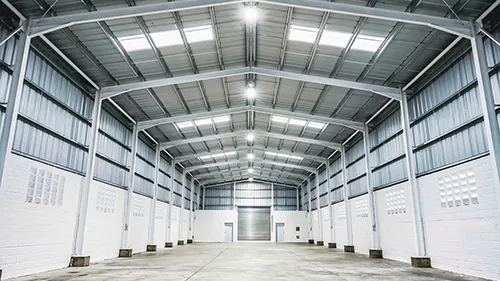
Ceiling height is the primary driver of LED high bay wattage selection. Higher ceilings require more powerful fixtures because light disperses over a greater distance before reaching the work plane. The rule of thumb for round LED high bay fixtures is:
- 15–20 feet (4.5–6m): 100W–150W LED high bay
- 20–25 feet (6–7.5m): 150W–200W LED high bay
- 25–35 feet (7.5–10.5m): 200W–300W LED high bay
- 35+ feet (10.5m+): 300W–500W LED high bay
These ranges assume standard 90–120 degree beam angles. Fixtures with narrower optics can use lower wattages at equivalent heights because they concentrate light downward more efficiently.
Understand Lumens, Not Just Watts
Watts measure energy consumption. Lumens measure actual light output. The two do not scale linearly across manufacturers — a quality 150W LED from one brand may produce more usable lumens than a budget 200W fixture from another. When comparing LED high bay options, always look at:
- Total lumens: The raw light output of the fixture
- Delivered lumens: Light that actually reaches the work surface (accounting for optical losses)
- Lumens per watt (efficacy): Higher is better. Quality industrial LED fixtures deliver 140–180 lumens per watt. Budget fixtures often fall below 130 LPW.
Define Your Illuminance Requirement
Different industrial tasks require different light levels, measured in foot-candles (fc) or lux (lx). Building codes, insurance standards, and OSHA guidelines specify minimum illuminance levels for various work environments:
- Warehousing and aisles: 10–20 foot-candles (108–215 lux)
- General manufacturing: 30–50 foot-candles (323–538 lux)
- Detailed assembly and inspection: 50–100 foot-candles (538–1,076 lux)
- Precision machining: 100–200 foot-candles (1,076–2,153 lux)
Use a lighting layout calculator or work with a lighting manufacturer that offers photometric planning to determine how many fixtures you need at your target wattage to hit these illuminance levels across your specific floor plan.
Account for Depreciation and Maintenance Factor
Light levels in a facility decline over time due to fixture aging, lens dirt accumulation, and room surface deterioration. Industry standards recommend applying a maintenance factor of 0.7–0.8 to initial illuminance calculations — meaning you should design for 125–143% of your target illuminance at installation to account for degradation over the fixture’s lifespan.
With LED, this degradation curve is far gentler than with traditional sources. A quality LED high bay at 50,000 hours (roughly 8 years at 16 hours/day) will still deliver over 90% of its initial output — compared to metal halide at 30–50% degradation within the same period.
Consider Light Color and CRI for Industrial Applications
LED high bay fixtures come in different correlated color temperatures (CCT), measured in Kelvin (K):
- 4000K (neutral white): Good all-purpose choice for mixed-use facilities
- 5000K (daylight white): Preferred for industrial and warehouse environments; matches natural daylight and supports visual alertness
- 5700K+: Available but less common; can appear harsh in some environments
For tasks requiring accurate color differentiation — quality control, packaging inspection, or areas where safety colors need to be clearly visible — choose fixtures with a CRI of 80 or higher. Many industrial facilities opt for 5000K / 80+ CRI as a standard specification.
Smart Controls and Dimming
One advantage of LED technology that directly affects wattage selection is dimming capability. Fixtures with 0-10V dimming or wireless controls allow you to specify a higher-output fixture and run it at reduced output — giving you flexibility that a fixed-output metal halide fixture simply cannot offer.
Practical applications:
- Daylight harvesting: Sensors reduce output near skylights during bright periods
- Occupancy zones: Full output in active areas, 20–30% output in unoccupied aisles
- Shift scheduling: Dim to 50–60% during off-hours for security lighting
Choosing fixtures with dimming capability and pairing them with a lighting control system can effectively reduce average energy consumption by 40–60% compared to running full output continuously.
Common Mistakes to Avoid
Choosing by price alone: Budget LED fixtures often use lower-quality LED chips and drivers that degrade faster, produce more glare, and carry shorter warranties. A fixture with a 3-year warranty at $80 is not a better deal than a 7-year warranted fixture at $150 when you factor in replacement labor and energy efficiency.
Ignoring glare ratings: High-bay fixtures with no glare control create visual discomfort in work areas. Look for fixtures with UGR (Unified Glare Rating) below 22 for industrial tasks, or choose frosted lens fixtures in areas where workers spend extended time.
Over-specifying: More wattage is not always better. An overlit facility wastes energy and can create glare and discomfort. Use photometric planning to size fixtures accurately rather than ordering uniformly powerful fixtures throughout.
A Practical Selection Checklist
Before purchasing LED high bay fixtures, have the following information ready:
- Ceiling height at mounting point
- Mounting type (chain, cable, surface, bracket)
- Required foot-candles at work plane (based on task type)
- Desired CCT and CRI
- Control requirements (on/off, dimming, smart integration)
- Operating hours per day
- Ambient temperature range (high-bay fixtures in unventilated ceiling spaces may need high-temperature-rated drivers)
Getting the wattage right is not about buying the most powerful fixture — it is about matching the fixture’s output to the specific visual requirements of your space. With LED’s superior energy efficiency and dimming flexibility, that match is easier to achieve and more cost-effective to maintain than any previous lighting technology.

 English
 Spanish
 French
 German
 Arabic
 Russian