
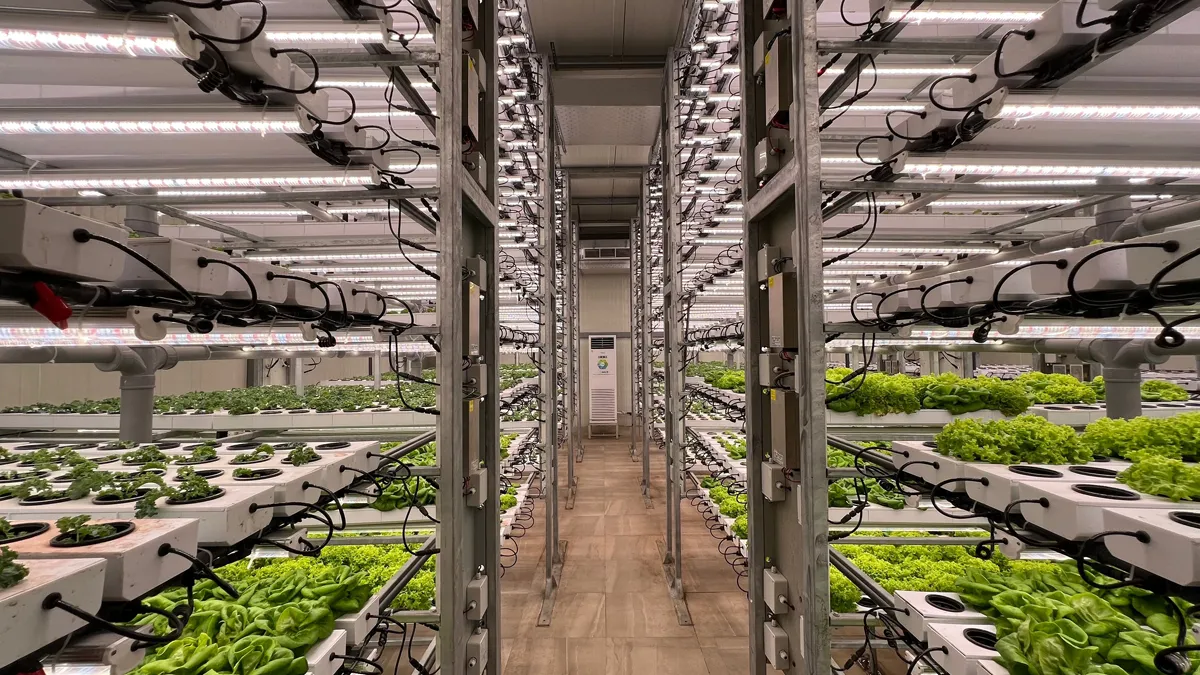
Why Photosynthesis Makes LED the Only Rational Choice for Greenhouses
Plants don’t care about lumens. They care about photons in the 400–700 nm range—what biologists call Photosynthetically Active Radiation (PAR). Traditional HPS (high-pressure sodium) fixtures dump half their energy into yellow/orange wavelengths that plants barely use, while generating enormous heat that forces growers to choose between lighting intensity and temperature control.
LEDs solve this by emitting only the wavelengths plants actually absorb. A well-designed horticultural LED spectrum places peaks at 450 nm (blue chlorophyll absorption) and 660 nm (red photosynthetic action), with optional 730 nm far-red to trigger shade-avoidance responses and accelerate flowering. The result: same or better growth with 40–60% less energy, and drastically less HVAC load because the fixtures run cool.
PPFD, DLI, and Why “Wattage” Is a Useless Spec for Grow Lights
If you’re comparing fixtures by watts, stop. For horticultural lighting, there are only two metrics that matter:
- PPFD (Photosynthetic Photon Flux Density) – the number of PAR photons actually hitting the canopy, measured in µmol/m²/s. This is the number you design your layout around.
- DLI (Daily Light Integral) – the cumulative PPFD over the photoperiod, expressed as mol/m²/day. Different crops have radically different DLI targets: leafy greens thrive at 12–17 mol/m²/day, while tomatoes and cannabis can demand 20–30+.
A common mistake: chasing peak PPFD at the center of the canopy while ignoring uniformity. If your map shows 800 µmol/m²/s directly under the fixture and 200 µmol/m²/s between rows, you’ll get patchy growth and uneven yields. Professional LED layouts use overlapping beam angles and spacing calculations to hold ±10% uniformity across the entire growing area.
Spectrum Tuning: It’s Not Just “Red + Blue = Pink”
Cheap “blurple” LEDs (intense blue + red) work, but they’re hard on grower eyes and miss nuances in plant development. Full-spectrum white LEDs with added deep-red deliver several advantages:
- Visual inspection: Growers can spot nutrient deficiencies, pests, and disease without supplemental lighting.
- Leaf morphology: Green-yellow wavelengths influence leaf expansion and stomatal behavior, improving biomass in some crops.
- Tunability: Modern fixtures with independent red/blue/white channels let you shift the spectrum through the crop cycle—blue-heavy for vegetative growth, red-heavy for flowering and fruiting.
For cannabis, research shows that adding 10–15% green light actually increases biomass compared to pure red-blue, because green penetrates deeper into the canopy where lower leaves would otherwise be light-starved.
Greenhouse Retrofit vs. Indoor Vertical Farm: Two Different Design Problems
In a greenhouse, you’re supplementing sunlight, not replacing it. That means your LED strategy changes by season and geography. In winter or high latitudes, you size the system to hit target DLI during the darkest month, with dimming controls to reduce output when natural light is sufficient. The fixtures need to survive high humidity, temperature swings, and occasional spray cleaning—IP65 rating is the floor, not the ceiling.
Indoor vertical farms have no natural light, so every photon costs electricity. Here, efficiency (µmol/J, photosynthetic photon efficacy) is the single biggest operating expense driver. A fixture at 2.8 µmol/J vs. 1.8 µmol/J translates directly to thousands of dollars per year in a commercial facility. The payback calculation is brutal and honest: if the LEDs aren’t efficient, the farm doesn’t make money.
HVAC Load: The Hidden 60% of Your Energy Bill
This is the stat that surprises most growers: in a sealed indoor farm, about 40–60% of HVAC energy is spent removing heat generated by the lights. HPS fixtures are essentially space heaters that happen to emit light. LEDs run cool, which means you can spec a smaller cooling system, lower your peak electrical demand, and in some cases avoid upgrading your facility’s main service panel.
The secondary benefit: because canopy temperature is more stable, you can run CO₂ enrichment more effectively. Plants under stable temperature conditions use CO₂ more efficiently, which compounds the yield gains from the LEDs themselves.
IP Rating, Chemical Resistance, and the Car Wash Effect
Greenhouse environments are corrosive. Between CO₂ injection, nutrient misting, pesticide/fungicide spraying, and high humidity, the air itself is trying to kill your fixtures. Look for:
- IP65 minimum (some vendors spec IP66 or IP67 for overhead spray zones)
- Epoxy-coated drivers and stainless steel hardware
- Gasket designs that don’t compress over time (silicone > neoprene)
- UL “Wet Location” listing, not just IP rating on paper
Some growers wash fixtures with pressurized water (the “car wash” approach). If that’s in your SOP, you need fixtures that have actually been pressure-tested, not just IP65-certified in a lab.
Controls: Photoperiod, Dimming, and Zoning
Horticultural LEDs should never run at 100% all the time. Modern controls deliver three layers of value:
- Photoperiod scheduling: Automating day/night cycles, with gradual sunrise/sunset ramps that reduce plant stress.
- DLI targeting: Dimming fixtures in real time based on a light sensor, so plants get consistent daily photon dose regardless of weather.
- Zoned spectrum control: Independent control of vegetative vs. flowering zones, or different recipes for different crop varieties in the same facility.
DALI and 0–10V are both common. For greenhouses, 0–10V is often sufficient and cheaper. For large indoor farms, DALI-2 gives you per-fixture addressing and diagnostics, which matters when you have 5,000+ fixtures and need to find the one that’s failing.
Crop-Specific Guidance: Leafy Greens, Tomatoes, Cannabis
Not all crops want the same recipe. Here’s the 2026 consensus from controlled-environment agriculture research:
- Leafy greens (lettuce, basil, spinach): 12–17 mol/m²/day DLI, 400–600 µmol/m²/s PPFD, higher blue (20–30%) to prevent elongation and improve flavor compounds.
- Tomatoes/peppers: 20–30 mol/m²/day DLI, 600–900 µmol/m²/s PPFD, lower blue (10–15%), strong red/far-red ratio to manage internode length.
- Cannabis: 25–35 mol/m²/day DLI in flower, 800–1,000 µmol/m²/s PPFD, spectrum shift from vegetative (more blue) to flower (more red/far-red). UV-B supplementation (290–315 nm) in the last 2–3 weeks of flower can increase trichome/terpene production, but requires careful dosing.
What to Check Before You Buy (2026 Vendor Checklist)
- Ask for an IES file or spectral power distribution (SPD) graph. If the vendor can’t provide one, walk away.
- Check independent photon efficacy testing. Some vendors advertise “3.0 µmol/J” based on component LEDs, not the assembled fixture with driver losses.
- Verify the warranty covers photon maintenance, not just functional failure. A fixture that loses 30% of its PAR output in 3 years is a warranty claim.
- Ask about the CCT of the white channel. 3000K–3500K is preferable for flower/fruit crops; 4000K+ for leafy greens and visual inspection comfort.
- Pressure-test the IP claim. Has the fixture been tested with the actual gaskets and seals used in production, or is the IP rating based on the enclosure alone?
The bottom line: horticultural LED lighting is a biological tool, not a general illumination product. Buy it like you’re specifying equipment for a lab, because that’s exactly what you’re doing.