
Why LED Panel Lights Are Replacing Troffers and Parabolic Fixtures in Industrial Ceilings
For decades, the standard answer for office-style ceilings in industrial facilities was the fluorescent troffer: a recessed, prismatic-lens fixture that hummed, flickered, and delivered uneven light. In the last five years, LED panel lights have systematically replaced those fixtures across manufacturing campuses, R&D buildings, quality-control labs, and administrative areas of industrial sites. The reasons are not just about energy savings —although those are substantial —but also about optical quality, glare control, dimensional flexibility, and integration with modern building control systems.
This guide examines where LED panel lights fit within an industrial lighting strategy, how to specify them correctly, what optical and electrical parameters matter most, how they compare to alternative luminaires in industrial ceilings, and which facilities benefit most from large-scale LED panel deployments. By the end, you will have a specification framework for evaluating LED panel lights for your own plant, warehouse office, or mixed-use industrial building.
What Is an LED Panel Light?
The LED integrated lighting fixture is a thin and flat lighting device, with its depth usually ranging from 10 to 60 millimeters. It features an LED array with edge lighting or straight lighting, enabling uniform lighting effects on diffused optical surfaces. Most of these fixtures are rectangular (the most common sizes being 2×2 feet / 595×595 millimeters or 2×4 feet / 1195×295 millimeters), but square, circular, and custom-shaped fixtures are also increasingly used in architectural applications.
The defining characteristics of an LED panel are:
- Low profile: Typically 1-2 inches deep, allowing installation in tight plenum spaces or surface-mount configurations where ceiling depth is limited.
- Uniform light distribution: High-quality panels achieve a luminance uniformity ratio (minimum/average) above 0.7 across the emitting surface, eliminating hot spots and providing a visually comfortable ceiling appearance.
- Glare control: Properly designed panels with micro-prismatic diffusers or louvered optics achieve UGR (Unified Glare Rating) below 19, making them suitable for computer workstations and detailed inspection tasks.
- Modular design: Most panels are designed to fit standard T-grid ceiling systems, enabling direct replacement of fluorescent troffers without ceiling modification.
Edge-Lit vs. Direct-Lit: Two Optical Architectures
LED panels are manufactured using two primary optical methods, each with implications for cost, thickness, and light quality:
Edge-Lit Panels: LEDs are mounted on the perimeter of the panel, firing into a light-guide plate (LGP) that distributes light uniformly across the diffuser surface. Edge-lit designs can be extremely thin (as little as 10 mm) but are more sensitive to LGP material quality and thermal management. They are the preferred choice for premium architectural applications where visual appearance matters.
Direct-Lit Panels: LEDs are mounted directly behind the diffuser in a grid pattern, similar to a traditional troffer but with a flat-face diffuser. Direct-lit panels are thicker (typically 40-60 mm) but offer higher efficacy (lumens per watt), lower cost, and better thermal performance for high-output applications. Most industrial installations use direct-lit panels for their balance of performance and value.
Industrial Applications for LED Panel Lights
LED panel lights are not typically used for high-bay manufacturing areas —those spaces require high-output luminaires such as LED high bays or linear LEDs. Instead, panels are the dominant choice for the auxiliary spaces that support industrial operations:
1. Quality Control and Inspection Labs
QC labs require high CRI (Color Rendering Index), low glare, and uniform illumination to prevent visual fatigue during detailed inspection work. LED panels with CRI >80 (preferably CRI >90) and UGR <19 are increasingly specified for these environments. The uniform surface appearance also reduces shadows on work surfaces, improving inspection accuracy.
2. Control Rooms and SCADA Centers
Industrial control rooms operate 24/7 and house operators monitoring screens, process visuals, and alarm systems. Poor lighting in these spaces contributes to eye strain, reduced alertness, and increased error rates. LED panels with 4000K-5000K CCT, low UGR, and dimming capability create an optimal visual environment. Integration with daylight sensors and occupancy controls further reduces operator fatigue by maintaining consistent illuminance as daylight conditions change.
3. Administrative Offices Within Industrial Facilities
Plant offices, HR departments, engineering workspaces, and meeting rooms within industrial campuses have the same lighting requirements as commercial offices. LED panels have become the default choice in these spaces because they deliver the optical quality of a premium luminaire at a competitive price point. For plants pursuing UL or DLC certification for their lighting systems, panels with DLC Premium listing deliver both rebate eligibility and verified performance.
4. Cleanrooms and Food Processing Areas
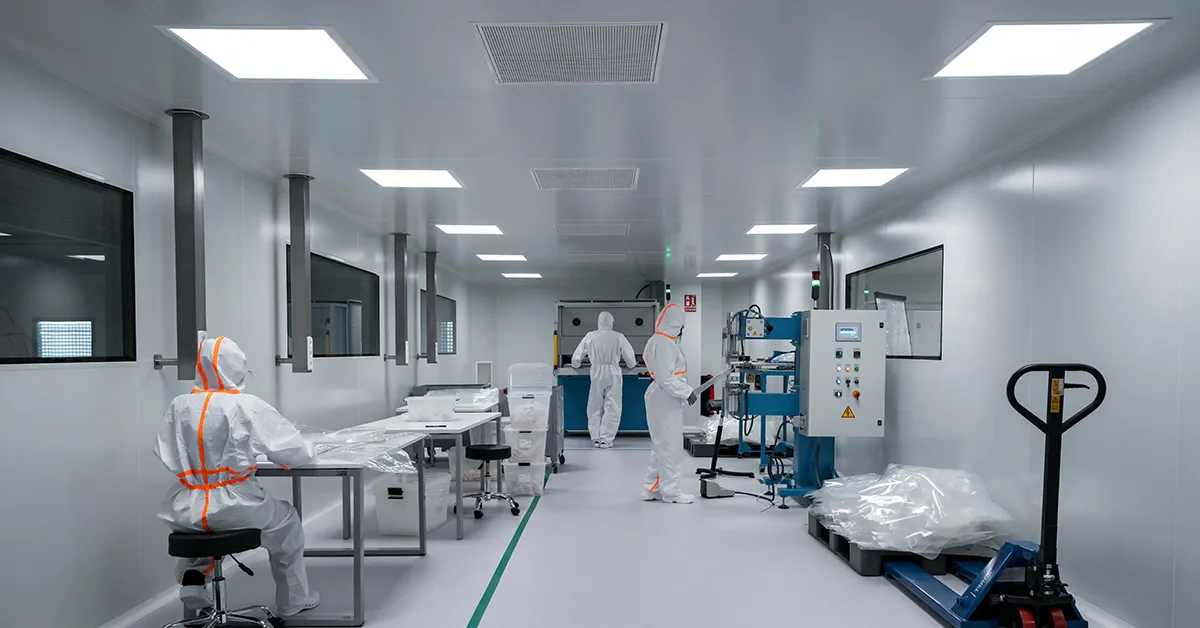
Cleanroom environments (ISO Class 7 and above) and food-processing areas require luminaires that do not shed particles, are easy to decontaminate, and resist frequent wash-down. LED panels with sealed, smooth-surface diffusers (IP54 or higher) and corners with sealed gaskets meet these requirements. Some manufacturers offer cleanroom-grade panels with no-crevice construction and chemical-resistant diffuser materials.
5. Hallways, Corridors, and Stairwells
Linear LED panels (narrow aspect ratio, 1×4 ft or 300×1200 mm) are frequently used in industrial corridors and stairwells. Their low profile and uniform appearance create a modern, well-lit pathway while consuming a fraction of the energy of fluorescent striplights. In emergency-exit applications, panels with integrated emergency drivers (90-minute backup) satisfy life-safety code requirements.
LED Panel Lights vs. Alternatives in Industrial Ceilings
Selecting the right luminaire for industrial auxiliary spaces means understanding how LED panels compare to the alternatives:
LED Panels vs. LED Troffers
LED troffers are deep-housing luminaires designed as direct replacements for fluorescent troffers. They are less expensive than panels but produce more glare and have a less uniform appearance. LED panels are the premium choice when visual comfort and ceiling aesthetics matter; LED troffers are the value choice for functional spaces where lighting quality is secondary to cost.
| Feature | LED Panel | LED Troffer |
|---|---|---|
| Profile depth | 10-60 mm | 100-150 mm |
| Glare (UGR) | Typically <19 | Typically 22-25 |
| Luminance uniformity | >0.7 | 0.4-0.6 |
| Efficacy (lm/W) | 100-130 | 110-140 |
| Cost (relative) | 1.2-1.5x | 1.0x (baseline) |
LED Panels vs. Linear LEDs (Wraparound / Vapor Tight)
Linear LEDs are the workhorse luminaire for industrial spaces. They are more robust, have higher IP ratings, and handle vibration better than panels. However, they are not suitable for office-style ceilings or spaces where visual comfort is a priority. The two luminaire types are complementary: linear LEDs for the plant floor, LED panels for the offices, labs, and control rooms.
Specification Framework: 8 Criteria for Selecting Industrial LED Panel Lights
1. Luminous Output and Spacing
LED panels are available from 2,000 to 6,000 lumens per panel. For a standard 2×4 ft panel in a 9-foot ceiling, 4,000-5,000 lumens typically delivers 30-40 footcandles on the workplane —adequate for general office tasks. For detailed inspection or drafting, specify 5,000-6,000 lumens per panel or reduce the spacing-to-mounting-height ratio. Use lighting design software (Dialux, AGi32) with IES photometric files from the manufacturer to verify uniformity ratios before purchasing.
2. Color Temperature (CCT)
Industrial auxiliary spaces generally use 4000K (neutral white) as the default CCT. It provides a balanced appearance that neither feels too warm (3000K) nor too sterile (5000K+). Control rooms and spaces with heavy computer use may benefit from 3500K to reduce blue-light exposure in night shifts. Manufacturing visibility areas (inspection booths) may use 5000K for maximum contrast and visual acuity.
3. Color Rendering Index (CRI) and TM-30
For quality-control labs and inspection areas, specify CRI >90. Standard industrial offices can use CRI 80-85. TM-30 Rf and Rg values provide a more modern assessment of color fidelity and saturation; panels with Rf >85 and Rg between 95-105 deliver natural color appearance for critical tasks. Recolux publishes TM-30 data on request for specification-grade projects.
4. Glare Rating (UGR)
UGR <19 is the EN 12464-1 recommendation for offices and visual display work. Panels achieve low UGR through micro-prismatic diffusers, louvered optics, or deep-cell baffles. Always request the UGR calculation report from the manufacturer for your specific room dimensions and mounting height —the panel’s UGR performance depends on the room geometry, not just the luminaire.
5. Dimming and Control Compatibility
Modern LED panels should support 0-10V dimming as a baseline. DALI (Digital Addressable Lighting Interface) compatibility is increasingly specified for large industrial campuses implementing centralized building management systems (BMS). For retrofits, verify that the existing control infrastructure (0-10V, DALI, Phase Dimming) matches the panel driver. Incompatible dimming systems are the most common cause of LED panel flicker complaints.
6. Ingress Protection (IP) Rating
For standard office ceilings, IP20 is sufficient. For cleanrooms, food processing, or areas subject to periodic wash-down, specify IP54 (dust protection, splash resistance) or IP65 (dust-tight, water-jet resistant). Note that higher IP ratings typically increase the panel thickness and may affect the aesthetics of the ceiling appearance.
7. Emergency Backup Duration
Life-safety codes (NFPA 101, IBC, local equivalents) require emergency egress lighting for a minimum of 90 minutes. LED panels with integrated emergency drivers add -60 to the fixture cost but eliminate the need for separate emergency luminaires. For facilities with centralized emergency power systems (generator-backed), verify that the panel driver can operate on generator-supplied power without flicker or restart delay.
8. Certification and Compliance
In the U.S. and Canada, LED panels for commercial and industrial use should carry UL 1598 (Luminaires) and UL 8750 (LED Equipment) listings. DLC Premium listing provides access to utility rebates and verifies performance through an independent testing protocol. In the EU, CE marking with EN 60598-1 compliance is mandatory; IEC 62471 (photobiological safety) compliance is recommended for panels used in spaces with prolonged human exposure.
Installation Methods for Industrial Ceilings
LED panels offer multiple installation configurations, making them adaptable to different ceiling types found in industrial facilities:
Recessed (T-Grid) Mount
The most common installation method. The panel replaces an existing fluorescent troffer in a suspended T-grid ceiling. No ceiling modification is required. Installation typically takes 5-10 minutes per fixture for a qualified electrician.
Surface Mount
For drywall or concrete ceilings without a T-grid system, a surface-mount frame (also called a back-box) creates a flush appearance. Surface-mount installations add 2-3 inches of depth but maintain the clean appearance of a recessed panel. This method is common in administrative offices that were not originally designed with drop ceilings.
Suspended (Pendant) Mount
For high ceilings (12 ft and above) in industrial auxiliary spaces, suspending the panel 24-36 inches below the ceiling brings the light source closer to the workplane, improving illuminance uniformity and reducing the total number of fixtures required. Suspended panels also create a modern, architectural appearance in customer-facing areas of industrial buildings.
Wall-Mount (Vertical Surface)
While less common, LED panels can be wall-mounted for corridor lighting, stairwell lighting, or accent lighting in industrial reception areas. Wall-mount configurations require a frame kit and should verify that the panel’s thermal management is designed for vertical orientation (some panels rely on convection cooling that assumes horizontal mounting).
Energy Savings: LED Panels vs. Fluorescent Troffers
A typical 2×4 ft fluorescent troffer uses two or three 32W T8 lamps plus ballast losses, consuming 70-90W per fixture. A comparable LED panel consumes 36-50W for the same or better light output. The energy reduction is 40-55% per fixture.
For a mid-size industrial facility with 200 panel/office fixtures operating 4,000 hours per year:
- Fluorescent baseline: 200 fixtures x 80W x 4,000 hrs = 64,000 kWh/year
- LED panel replacement: 200 fixtures x 40W x 4,000 hrs = 32,000 kWh/year
- Annual energy savings: 32,000 kWh
- Cost savings (at .12/kWh): ,840 per year
- Maintenance savings: Eliminating quarterly lamp replacement saves an estimated ,000/year in labor and materials
- Total annual savings: ~,840
- Payback period: 18-24 months for a typical LED panel retrofit
Common LED Panel Quality Issues and How to Avoid Them
Not all LED panels deliver on their specifications. The following issues are common in low-cost or improperly specified panels:
Flicker and Stroboscopic Effect
Panels with low-quality drivers exhibit visible flicker at certain dimming levels or even at full output (especially when operated on non-sinusoidal LED drivers). Specify panels with a flicker percentage <5% and stroboscopic effect (Pst LM) <1.0. Request the flicker test report from the manufacturer; if they cannot provide one, consider it a red flag.
Color Shift and Tint Issues
Poor binning of LEDs can cause noticeable color differences between panels in the same space. Specify SDCM (Standard Deviation of Color Matching) <3 steps MacAdam ellipse. Panels assembled with LEDs from a single bin and verified with a color spectrometer during production maintain consistent appearance across large installations.
Premature Driver Failure
The LED driver (power supply) is the most common failure point in LED panels. Panels with electrolytic capacitors in the driver typically fail after 20,000-30,000 hours. Specify drivers with film capacitors or electrolytic capacitors rated for 105°C operation. Drivers from established brands (Mean Well, Osram, Philips, Tridonic) have significantly better track records than generic imported drivers.
Thermal Management and Lumen Depreciation
LED panels installed in insulated ceiling plenums can overheat, causing accelerated lumen depreciation (the L70 lifetime drops from 50,000 hours to 20,000 hours or less). Verify that the panel’s thermal design accounts for restricted airflow in insulated ceilings. Panels with aluminum heat sinks and thermal management circuits that reduce current at high temperatures maintain rated lifetime in challenging thermal environments.
Integrating LED Panels with Building Controls
Industrial facilities are increasingly adopting centralized lighting controls for energy management, compliance reporting, and integration with HVAC and security systems. LED panels are well-suited to control integration because their low DC voltage and driver-based architecture make dimming and switching straightforward.
Gradation 0-10V
The most widely used analog dimming standard. A 0-10V control signal adjusts the panel output from 100% (10V) to 1-10% (0V). 0-10V is——? reliable, and compatible with most industrial lighting control systems. The limitation is that it does not provide feedback on fixture status (on/off/dim level) to the control system.
DALI (interface numérique d'éclairage adressable)
DALI is a two-way digital communication protocol that allows individual addressing of up to 64 luminaires per DALI line. It provides fixture-level dimming, status feedback, and energy monitoring. DALI is increasingly specified for large industrial campuses and facilities pursuing LEED or BREEAM certification, where lighting energy reporting is required.
Wireless Controls (Zigbee, Bluetooth Mesh)
Wireless control systems eliminate control wiring, reducing installation cost for retrofits. LED panels with embedded wireless modules can be commissioned via smartphone app, making them attractive for small-to-mid-size industrial facilities without dedicated building automation infrastructure. The trade-off is that wireless systems introduce potential cybersecurity considerations in industrial environments; consult your IT/OT security team before deploying wireless lighting controls in process areas.
Recolux LED Panel Solutions for Industrial Applications
Recolux manufactures a full range of LED panel lights engineered for industrial auxiliary spaces, control rooms, cleanrooms, and administrative areas. Our panel portfolio includes:
- Recolux Edge-Lit Panel Series: 10 mm ultra-thin profile, CRI >90, UGR <16, available in 2×2 ft, 2×4 ft, and custom sizes. Ideal for architectural applications, control rooms, and executive spaces where visual comfort is the priority.
- Recolux Direct-Lit Panel Series: 40 mm profile, 110-130 lm/W efficacy, 0-10V and DALI dimming options, IP20 and IP54 versions. The workhorse panel for industrial offices, QC labs, and corridor lighting.
- Recolux Cleanroom Panel Series: ISO Class 7 compatible, smooth-surface sealed diffuser, chemical-resistant materials, IP65 rating. Designed for pharmaceutical manufacturing, food processing, and electronics assembly cleanrooms.
- Recolux Emergency Panel Series: Integrated 90-minute emergency backup, self-testing functionality, compliant with NFPA 101 and IBC emergency egress requirements.
All Recolux LED panels ship with IES photometric files, spectral power distribution reports, and TM-30 data for specification-grade projects. Contact our industrial lighting team for DIALux simulations, photometric calculations, and application-specific panel recommendations.
Questions fréquemment posées
Q: Can LED panels be used in damp or wet locations?
A: Standard LED panels (IP20) are not suitable for damp or wet locations. For areas subject to moisture, specify panels with IP54 (damp location) or IP65 (wet location) ratings. These panels have sealed diffusers, gasketed corners, and moisture-resistant drivers. Always verify the IP rating on the product label and certification documents before installing in moisture-prone areas.
Q: How long do LED panels typically last?
A: Quality LED panels are rated for 50,000 to 75,000 hours of L70 life (the point at which light output declines to 70% of initial). At 12 hours/day operation, that translates to 11-17 years before a luminaire replacement is needed. The LED driver is typically the first component to fail; selecting panels with high-quality drivers (Mean Well, Osram, Tridonic) extends the system lifetime significantly.
Q: Can I mix LED panels with existing fluorescent troffers during a phased retrofit?
A: Yes, but be aware of color temperature and lumen output differences. A space with both LED panels and fluorescent troffers will have noticeable color and brightness variations that can be visually distracting. If a phased retrofit is necessary, group the LED panels in defined zones (e.g., one office wing at a time) rather than mixing them randomly. Better still, replace all troffers in a given space at once to maintain consistent appearance.
Q: Do LED panels work with existing ceiling grids?
A: Yes, most LED panels are designed to fit standard T-grid ceiling systems (15/16-inch or 9/16-inch grid). Before ordering, measure the grid opening dimensions and verify compatibility with the panel manufacturer. Some premium panels require specific grid types for proper seismic support; consult the installation manual for seismic clip requirements in your region.
Q: Are LED panels compatible with emergency generator power?
A: Most LED panels with high-quality drivers operate normally on generator power. However, some low-cost panels use drivers that cannot handle the frequency variation during generator start-up (the transition from utility power to generator power). For facilities with generator-backed emergency systems, specify panels with a wide input voltage range (100-277V) and frequency tolerance (50/60 Hz ?10%). Test a sample panel on generator power before purchasing in quantity.
Q: What is the optimal color temperature for industrial offices with computer work?
A: 3500K-4000K is optimal for spaces with prolonged computer use. These CCT values provide adequate visual alertness without the high blue-light content of 5000K+ sources, which can contribute to circadian rhythm disruption during evening shifts. For mixed-use spaces (computer work plus occasional paper tasks), 4000K provides the best balance. Consider tunable white panels that allow adjusting CCT throughout the day to support circadian health.
Conclusion: LED Panels as Part of an Integrated Industrial Lighting Strategy
LED panel lights will not replace high-bay luminaires for manufacturing floors, nor should they. Their role is to deliver premium light quality in the auxiliary spaces that support industrial operations: the control rooms where process decisions are made, the QC labs where product quality is verified, the offices where engineers design the next generation of equipment, and the corridors that connect these spaces safely and comfortably.
Specifying LED panels correctly requires attention to optical quality (UGR, CRI, uniformity), control compatibility (0-10V, DALI, wireless), certification (UL, DLC, CE), and thermal management. The upfront cost premium over basic LED troffers is typically recovered in 18-24 months through energy savings and eliminated lamp-replacement labor. Over a 10-year lifecycle, the total cost of ownership strongly favors quality LED panels over fluorescent troffers and even over basic LED alternatives.
If you are planning an LED panel retrofit for your industrial facility, explore Recolux’s full industrial LED lighting portfolio or contact our specification team for a customized lighting design proposal tailored to your facility’s layout, operating hours, and performance requirements.
 English
 Spanish
 French
 German
 Arabic
 Russian