
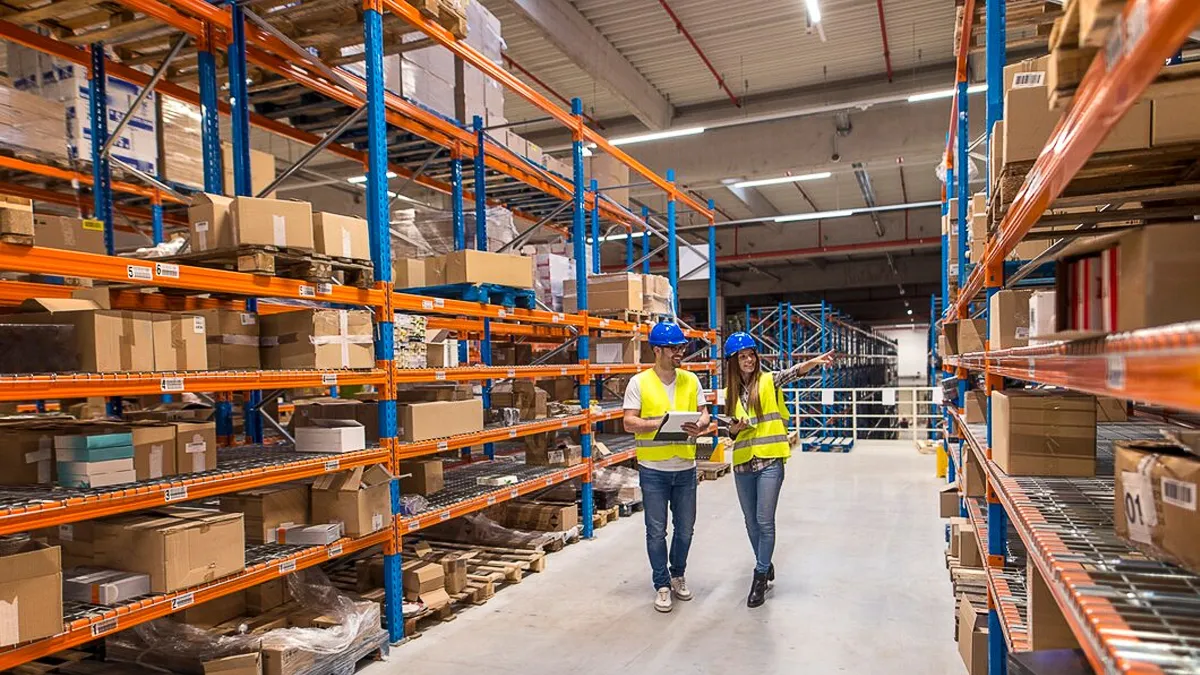
Warehouse and logistics center lighting presents unique challenges: high ceilings (6-15 meters), 24/7 operations, extreme temperature variations, dust and vibration exposure, and the critical need for visual acuity in picking, packing, and inventory management. This guide provides evidence-based design strategies for LED high-bay lighting that enhance safety, productivity, and energy efficiency in demanding logistics environments.
Warehouse Lighting Design Criteria
Effective warehouse lighting design balances illuminance, uniformity, glare control, and energy efficiency while accounting for the specific visual tasks performed in each zone.
Illuminance Standards (IES RP-7-2023)
| Warehouse Zone | اللوكس الموصى به (فوت) | التوحيد (الحد الأدنى/المتوسط) | Color Rendering (CRI) |
|---|---|---|---|
| General storage (bulk stacking) | 100-150 lux (10-15 fc) | 0.4 | ≥70 |
| Aisle ways (narrow, <3m) | 200-300 lux (20-30 fc) | 0.5 | ≥70 |
| Order picking (manual) | 300-500 lux (30-50 fc) | 0.6 | ≥80 |
| Packing & shipping | 500-750 lux (50-75 fc) | 0.6 | ≥80 |
| Quality inspection | 750-1000 lux (75-100 fc) | 0.7 | ≥85 |
| Loading docks | 200-300 lux (20-30 fc) | 0.5 | ≥70 |
Critical Design Factors
- Mounting height: Determines beam angle and fixture spacing (6m, 9m, 12m, 15m+ require different optical strategies)
- Uniformity ratio: Minimize shadows and dark spots that cause accidents and slow order picking
- Glare rating (UGR): Keep UGR <22 for areas with sustained visual tasks; <28 acceptable for circulation
- Color temperature: 4000K-5000K balances visual acuity and worker alertness without excessive blue light
- Switching/dimming zones: Match lighting zones to operational areas to avoid illuminating unused spaces
High-Bay LED Fixture Selection
Optical Performance
High-bay LEDs must deliver specified illuminance at floor level while maintaining uniformity. Key optical parameters:
- Beam angle: 60° for 6-9m ceilings, 90° for 9-12m, 120° for >12m (or multiple fixtures with narrower beams)
- Lumen output: 20,000-40,000 lumens per fixture for typical warehouses (150W-300W equivalent)
- Lumen maintenance: L70 >100,000 hours ensures <10% light loss over 10+ years
- Optical design: Die-cast aluminum reflectors or precision lens arrays minimize light trespass and maximize货架illumination
Mechanical Durability
Warehouse environments are punishing: temperature extremes, vibration, dust, moisture, and potential physical impact. Specify fixtures with:
- Ingress protection: IP65 minimum for dusty environments; IP66 for wash-down areas
- IK rating: IK08 (5 Joule impact resistance) for areas with forklift traffic
- Operating temperature: -40°C to +50°C for freezer/cooler warehouses
- Vibration resistance: IEC 60068-2-6 certified for areas near heavy machinery
- Corrosion protection: Salt spray tested (ASTM B117) for coastal or chemical storage facilities
Electrical Reliability
- Driver quality: Use constant-current drivers with >90% efficiency and <10% total harmonic distortion (THD)
- Surge protection: 6kV/3kA built-in surge protection; 20kV external SPD for lightning-prone areas
- معامل القدرة: >0.95 to minimize reactive power penalties
- Dimming compatibility: 0-10V, DALI, or wireless control for daylight harvesting and occupancy sensing
Challenging Environment Strategies
Cold Storage & Freezer Warehouses
Refrigerated warehouses (-18°C to -30°C) require specialized LED fixtures that start instantly, maintain lumen output, and resist thermal cycling stress.
- Low-temperature drivers: Specify drivers rated for -40°C startup with cold-weather startup circuits
- Thermal management: Use fixtures with isolated driver compartments to prevent condensation
- Lens material: Polycarbonate or acrylic lenses resist impact at low temperatures (glass can shatter)
- Heated fixtures: For ambient <-25°C, select fixtures with integrated heaters to prevent lens fogging
- Mounting: Use stainless steel hardware to prevent galvanic corrosion from condensation
High-Dust & Particulate Environments
Warehouses storing flour, cement, metals, or agricultural products accumulate dust that reduces light output and creates explosion risks.
- Smooth housing: Rounded, non-porous fixture housings prevent dust accumulation
- Conformal coating: PCB boards with moisture/particulate-resistant coating (IPC-CC-830B)
- Sealed optical chamber: IP65+ rating prevents dust ingress into LED compartment
- EX-rated fixtures: For combustible dust (NFPA 70 NEC Class II), use UL 844 certified explosion-proof fixtures
- Cleaning access: Design with removable optical chambers for periodic cleaning without disrupting operations
High-Vibration Areas (Near Conveyors & Machinery)
- Vibration testing: Specify fixtures tested to IEC 60068-2-6 (sinusoidal) and IEC 60068-2-64 (random)
- Mounting hardware: Use spring-loaded or elastomeric mounting brackets that absorb vibration
- Wiring: Use flexible conduit and strain-relieved connections to prevent wire fatigue
- Driver protection: Potting compound (silicone or epoxy) encapsulates driver components against vibration damage
Outdoor & Semi-Outdoor Loading Areas
- Wet location rating: IP66 for exposed areas; NEMA 4X enclosure for corrosion resistance
- Photocell control: Dusk-to-dawn operation with 0-10V dimming for energy savings
- Bug rating: Select fixtures with BUG (Backlight, Uplight, Glare) ratings <5 to minimize light pollution and comply with dark-sky ordinances
- Surge protection: 20kV split-mass arrester for open-area lightning protection
Lighting Layout & Photometric Design
Computational Modeling (AGi32, Dialux)
Never guess lighting layouts. Use IESNA-certified photometric software to model illuminance, uniformity, and glare:
- Import IES/LDT files from fixture manufacturer
- Model racking layout, ceiling height, and reflectance values (ceiling 50%, walls 50%, floor 20%)
- Calculate point-by-point illuminance and generate iso-lux contour plots
- Optimize fixture spacing (typically 2-3x mounting height for uniform illumination)
- Verify UGR calculations for visual comfort
Spacing-to-Height Ratio (SHR)
| Ceiling Height | Recommended SHR | Fixture Spacing | Beam Angle |
|---|---|---|---|
| 6-9 meters | 1.5:1 to 2:1 | 9-18 meters | 60° to 90° |
| 9-12 meters | 2:1 to 2.5:1 | 18-30 meters | 90° to 120° |
| 12-15 meters | 2.5:1 to 3:1 | 30-45 meters | 120° (or multiple 60°) |
Energy Efficiency & Control Strategies
Daylight Harvesting
Warehouses with skylights or translucent panels can reduce artificial lighting energy by 30-60% using daylight harvesting:
- Install photocells near daylight openings
- Set dimming zones aligned with daylight penetration (typically 3-5m from windows/skylights)
- Use open-loop control (fixed dimming schedule based on solar position) or closed-loop (real-time photocell feedback)
- Ensure dimming range extends to 10% (not 0%) to maintain minimum safety illumination
Occupancy & Vacancy Sensing
- High-bay occupancy sensors: Use 360° ceiling-mounted sensors with 12-15m range
- Time delay: Set 5-10 minute off-delay to avoid frequent switching in active areas
- Zoning: Match sensor zones to aisle ways or work cells; avoid large open zones that keep all lights on when only one area is occupied
- Manual override: Provide switch or app-based override for manager control during inventory or cleaning
Networked Lighting Control (NLC)
Large warehouses (>5,000 m²) benefit from NLC systems that provide centralized monitoring, energy dashboards, and predictive maintenance:
- Monitor individual fixture energy use and operating hours
- Receive alerts for driver failures or significant lumen depreciation
- Schedule lighting based on shift patterns (e.g., dim to 30% during night shifts in unoccupied zones)
- Integrate with BMS for holistic energy management
Retrofit Considerations: From HID to LED
Existing Infrastructure Assessment
- Evaluate existing mounting (pendant, surface, chain)
- Check voltage availability (120V, 277V, 347V, 480V)
- Assess control wiring (if any) for compatibility with LED dimming
- Measure existing illuminance to establish baseline
Retrofit Options
| Strategy | Description | Pros | Cons |
|---|---|---|---|
| Lamp-and-ballast replacement | Plug-and-play LED lamps in existing HID fixtures | Lowest upfront cost, minimal labor | Limited performance, compatibility issues, safety risks |
| Retrofit kits | Replace optical assembly and driver, reuse housing | Moderate cost, retains mounting | Existing housing may be degraded, limited optical options |
| Full fixture replacement | Remove old fixtures, install new LED high-bays | Best performance, full warranty, optimal optics | Highest upfront cost, disposal of old fixtures |
Commissioning & Maintenance
Post-Installation Verification
- Measure illuminance at floor level (10-20 measurement points per 1,000 m²)
- Verify uniformity ratio meets design intent
- Test control systems (occupancy sensors, photocells, dimming)
- Document as-built lighting layout and control zone map
Preventive Maintenance
- Quarterly: Clean lenses (dust can reduce output by 15-30%)
- Annually: Verify illuminance levels and compare to baseline
- Every 3-5 years: Replace failed drivers or complete fixtures approaching L70
- Continuous: Monitor energy use via NLC dashboard for anomalies
ROI & Financial Incentives
Energy Savings Calculation
Typical warehouse LED retrofit achieves:
- 50-70% energy reduction compared to HID (metal halide, HPS)
- Payback period: 2-4 years (depending on electricity rates and incentives)
- Utility rebates: $15-40 per fixture (varies by utility and region)
Incentive Programs
- Utility rebates: Prescriptive or custom incentives based on measured energy savings
- Tax deductions: EPAct 179D (USA) provides up to $1.80/sq ft for energy-efficient lighting
- Accelerated depreciation: MACRS 5-year schedule for lighting upgrades
الخلاصة
Warehouse and logistics center LED lighting design demands a holistic approach that balances illuminance requirements, environmental challenges, energy efficiency, and control flexibility. By selecting high-bay fixtures engineered for harsh conditions, leveraging photometric modeling for optimal layouts, and implementing intelligent controls, facility managers can achieve safer working conditions, enhanced productivity, and substantial energy cost savings. As warehouses evolve into automated fulfillment centers, lighting systems must also adapt—integrating with IoT sensors, autonomous robots, and smart building platforms to support the next generation of logistics operations.
Ready to upgrade your warehouse lighting? Contact our lighting design team for a free photometric analysis and customized LED retrofit proposal.