
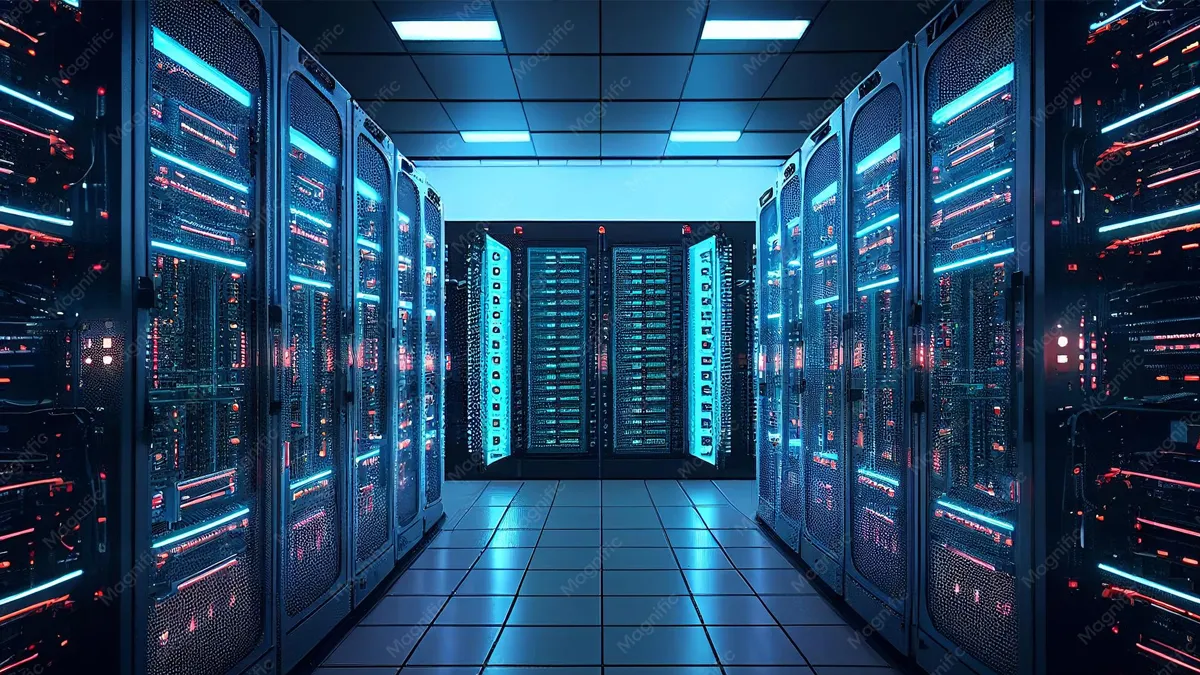
Data centers and server rooms operate 24 hours a day, 365 days a year. These mission-critical facilities demand lighting systems that match their reliability. Traditional fluorescent or metal halide fixtures fail prematurely in these environments — frequent switching, constant operation, and elevated ambient temperatures degrade performance fast.
LED lighting solves these problems. But not all LEDs are created equal. This guide covers what facility managers and data center operators need to know when specifying LED lighting for server rooms, colocation facilities, and enterprise data centers.
Why Data Centers Need Specialized LED Lighting
Data centers present a unique operating environment. Ambient temperatures in server aisles routinely reach 24–27°C (75–80°F) under normal operation, and can spike higher during cooling system maintenance or peak loads. Humidity is tightly controlled. Equipment runs continuously. Power quality matters — every watt counts toward PUE (Power Usage Effectiveness).
Standard office LEDs often fail prematurely in these conditions. Here’s why data center-specific LED fixtures are different:
- Thermal tolerance: Driver electronics rated for ambient temperatures up to 45–50°C, not the standard 35°C limit.
- 24/7 rated lifetime: L70 lifetimes calculated for continuous operation, not 8-hour daily use.
- Power quality: Low harmonic distortion (THD <10%) to avoid contaminating UPS output.
- Instant-on reliability: No warm-up time, no restrike delay after power interruption.
- EMI/EMC compliance: Shielding to prevent interference with sensitive server equipment.
Thermal Management: The Critical Factor
Heat is the enemy of LED lifetime. Every 10°C increase in operating temperature above design limits cuts LED lifetime roughly in half. In data centers, the combination of high ambient temperature and 24/7 operation creates a harsh environment for poorly designed fixtures.
What to Look For
- Separated driver compartment: Driver runs hotter than LEDs. Physical separation extends driver life.
- Aluminum heat sinks: Passive cooling with adequate surface area. Avoid plastic housings in hot aisles.
- Temperature-rated drivers: Look for drivers specified to 50°C or 60°C ambient (not 35°C).
- Thermal cutoff protection: Automatic dimming or shutdown if internal temperatures exceed safe limits.
- Lifetime derating data: Manufacturer should provide L70 lifetime at actual operating temperatures, not just at 25°C.
24/7 Operation and L70 Lifetime Calculation
Most LED fixtures are rated for 50,000–100,000 hours at 8–10 hours per day (L70 standard — 70% of initial light output remaining). For 24/7 operation, that same fixture reaches L70 in roughly one-third the calendar time.
A fixture rated for 100,000 hours at 10 hours/day (27 years to L70) will reach L70 in about 11 years under continuous 24/7 operation. For data centers with a 10–15 year facility lifecycle, specify fixtures with L70 >150,000 hours, or plan for mid-life fixture replacement.
TM-21 Extrapolation
Ask manufacturers for TM-21 extrapolated lifetime data. This IES standard projects LED lifetime beyond the limited duration of LM-80 testing. For data centers, insist on TM-21 projections at the actual operating temperature of your facility, not just at 25°C lab conditions.
Power Quality and UPS Compatibility
Data centers run on UPS (Uninterruptible Power Supply) systems. When utility power fails, lighting must transition seamlessly to backup power without causing harmonics that disrupt sensitive IT loads.
- Total Harmonic Distortion (THD): Specify <10% THD. Poor LED drivers can introduce harmonics that cause UPS alarms or transformer heating.
- Power factor: >0.9 power factor reduces reactive power load on UPS systems.
- Wide input voltage range: 100–277V or 347–480V drivers handle voltage fluctuations during generator transition.
- Flicker-free drivers: <1% flicker at all dimming levels. Some LED drivers produce invisible flicker that can interfere with video surveillance or machine vision systems in the data center.
Lighting Layout for Data Centers
Raised Floor vs. Slab-on-Grade
Raised floor data centers have limited ceiling height above the raised floor (often 2.5–3 meters). This limits fixture selection — low-profile linear LEDs or recessed troffers work best. Avoid deep high-bay fixtures that reduce available headroom.
Slab-on-grade data centers (often in repurposed industrial buildings) have higher ceilings (4–8 meters). High-bay LEDs with narrow beam angles (60° or less) direct light to the floor without wasting output on walls or ceilings.
Hot Aisle / Cold Aisle Layout
In row-based cooling layouts, the hot aisle (rear of server racks) often has the poorest visual access — racks block overhead light. Specify asymmetric beam angle fixtures or add task lighting in hot aisles to ensure technicians can read labels and perform maintenance.
Recommended Light Levels (IES/EN Standards)
| Area | Recommended Lux (fc) | Uniformity (Min/Avg) | Color Temperature | CRI |
|---|---|---|---|---|
| Server aisles (general) | 300–500 lux (30–50 fc) | >0.4 | 4000K–5000K | >80 |
| Test/repair benches | 750 lux (70 fc) | >0.6 | 5000K | >85 |
| Control room/OPS | 500 lux (50 fc) | >0.6 | 3500K–4000K | >80 |
| Electrical rooms | 300 lux (30 fc) | >0.4 | 4000K | >80 |
| Corridors/stairwells | 100–200 lux (10–20 fc) | >0.3 | 4000K | >80 |
Emergency Lighting and Redundancy
Data centers require emergency lighting on UPS or generator backup. Two approaches:
- Centralized emergency lighting inverter: A dedicated UPS powers a subset of fixtures during outage. Most efficient for large facilities.
- Built-in battery backup: Each fixture has an internal battery (typically 90-minute runtime). Simpler but harder to maintain across hundreds of fixtures.
For data centers, the centralized inverter approach is preferred — it’s easier to test and maintain, and the集中式应急照明逆变器 approach allows dimming control during normal operation.
Controls and Energy Optimization
Data centers operate 24/7, but occupancy is intermittent. Lighting controls cut energy waste during unoccupied periods:
- Occupancy sensors: PIR or microwave sensors in aisles automatically switch off lights when no one is present. Look for <1-minute timeout to avoid nuisance switching during focused work.
- Daylight harvesting: If the data center has skylights or windows (uncommon but not rare), dimmable LEDs adjust output based on available daylight.
- Scheduled dimming: Reduce light levels to 50% during known unoccupied overnight periods (with manual override).
- Zone control: Divide the facility into lighting zones matching security access zones. Only illuminate areas where staff are present.
Potential energy savings: 30–50% compared to continuous full-output operation.
Fixture Selection Checklist
- □ L70 lifetime >150,000 hours (TM-21 extrapolated at operating temperature)
- □ Driver rated for 45–50°C ambient temperature
- □ THD <10%, power factor >0.9
- □ Flicker-free (<1% at all dimming levels)
- □ EMI/EMC compliant (FCC Part 15, EN 55015)
- □ IP40 or higher (dust protection in raised floor environments)
- □ IK08 or higher impact rating (accidental contact with equipment)
- □ 0–10V or DALI dimming compatible
- □ UL/cUL 1598, IEC 60598 certified
- □ 5-year warranty minimum (10-year preferred for premium fixtures)
Cost Analysis: LED vs. Fluorescent in Data Centers
Fluorescent lighting in data centers fails frequently due to constant operation and elevated temperatures. Lamp replacement in a large data center can require hundreds of man-hours per year — each fixture requiring a lift and safety protocols around live IT equipment.
LED retrofit payback for data centers typically ranges 1.5–3 years, driven primarily by reduced maintenance labor (not just energy savings). For a 5,000 m² data center with 500 fixtures, the numbers look like this:
- Fluorescent: 2 lamp replacements per year × 500 fixtures = 1,000 lamp changes/year
- LED: 0–1 fixture replacements in year 10 (L70 >100,000 hours)
- Labor savings: ~200 hours/year × hourly rate = significant OPEX reduction
- Energy savings: 40–60% reduction in lighting energy (on top of maintenance savings)
Installation Considerations
Installing lighting in an operational data center requires coordination:
- ESD protection: Crews must use anti-static footwear and grounding straps when working near server racks.
- Limited work windows: Install during scheduled maintenance windows or low-occupancy periods.
- Fall protection: Overhead work in data centers often requires certified scaffolding (not lifts, which can damage flooring or obstruct aisles).
- Dust containment: Cutting or drilling above the data floor requires plastic containment to prevent debris from entering the raised floor plenum (where it can be drawn into server intakes).
Future Trends: Smart Lighting in Data Centers
Next-generation data centers are integrating lighting with facility management systems:
- Asset tracking: Bluetooth Low Energy (BLE) beacons embedded in light fixtures track rack-mounted equipment and personnel movement.
- Power monitoring: Individual fixture power draw reported to BMS (Building Management System) for detailed energy analytics.
- Predictive maintenance: Fixture-reported thermal data predicts driver failure before it occurs, enabling planned replacement.
- Li-Fi: Experimental — using LED light for high-speed data transmission within the data center (eliminates RF interference concerns).
Conclusion
Data center LED lighting is not a standard office lighting project. The combination of 24/7 operation, elevated temperatures, power quality requirements, and mission-critical reliability demands fixtures designed specifically for these conditions. Specify LED fixtures with high-temperature-rated drivers, TM-21 lifetime data at operating temperature, low THD, and robust thermal management. The upfront cost premium over standard LEDs pays for itself through reduced maintenance and reliable 24/7 operation.