
Facility managers across food processing plants, pharmaceutical manufacturing sites, and cold chain logistics hubs are facing a challenge that traditional chemical sanitation methods alone can no longer fully address: the need for continuous, residue-free disinfection that does not interrupt production workflows. UV-C germicidal lighting — particularly the newer generation of UV-C LED systems purpose-built for industrial environments — is emerging as a practical complement to established cleaning protocols. This guide covers how UV-C technology works, where it fits in industrial facilities, what standards govern its use, and how to evaluate and specify fixtures for real-world applications.
What Is UV-C Germicidal Lighting?
Ultraviolet (UV) light is electromagnetic radiation with wavelengths between 10 and 400 nanometers. The germicidal range — the wavelengths that inactivate microorganisms — falls between 200 and 300 nanometers, with peak effectiveness at approximately 265 nanometers. This is where UV-C LEDs operating at 260-280 nm have their strongest disinfection performance.
UV-C photons are absorbed by the microorganisms’ DNA and RNA, causing photochemical damage that prevents replication. Bacteria, viruses, molds, yeasts, and bacterial spores — all of which are challenges in industrial environments — are susceptible to UV-C at sufficient exposure doses. The critical variable is the product of UV intensity (measured in microwatts per square centimeter, uW/cm2) and exposure time, expressed as a UV dose in millijoules per square centimeter (mJ/cm2). Higher doses provide greater log reductions in microbial load.
For context: a dose of approximately 5-10 mJ/cm2 achieves a 99.9% reduction (3-log) in many common bacteria and viruses. Some resistant organisms, such as bacterial spores or certain fungal spores, require 20-50 mJ/cm2 or higher. This is why matching the UV-C output to the target pathogen is a fundamental step in system design.
How UV-C LEDs Differ from Traditional Mercury UV Lamps
The industrial UV disinfection market historically relied on low-pressure and medium-pressure mercury vapor lamps, which emit UV-C at 254 nm. These are well-understood, proven technology, but they come with operational constraints that UV-C LEDs are designed to address.
| Parameter | Mercury UV Lamp | UV-C LED |
|---|---|---|
| Peak wavelength | 254 nm (fixed) | 260-280 nm (tunable) |
| Warm-up time | 30 seconds to several minutes | Instantaneous (on/off) |
| Operational temperature range | Narrow – performance degrades in heat/cold | Wide – suitable for cold storage and process heat zones |
| Mercury content | Contains mercury – disposal regulated | Mercury-free – RoHS compliant |
| Lamp life | 8,000-16,000 hours | Up to 50,000-100,000 hours |
| Form factor | Tubular – limited mounting flexibility | Solid-state – flexible module and strip layouts |
| Dimming / smart control | Limited compatibility | Full 0-10V, PWM, and IoT integration |
| Instant restrike after power loss | No – requires re-strike time | Yes |
UV-C LEDs have historically lagged mercury lamps in output intensity (radiant flux per module), which limited their adoption for large-area disinfection applications. That gap is narrowing rapidly as LED chip manufacturers improve photon efficiency in the deep-UV range. For industrial applications, the combination of mercury-free operation, instant switching, and narrow spectral output (which concentrates germicidal energy rather than wasting it in non-germicidal wavelengths) makes UV-C LEDs increasingly the preferred choice for new installations.
Industrial Applications for UV-C Germicidal LED Lighting
UV-C disinfection systems serve distinct functions in industrial settings, and understanding those functions is key to proper fixture selection.
Food Processing and Cold Chain Facilities
Food processing environments face ongoing pressure from microbial contamination — Listeria, Salmonella, E. coli, and spoilage organisms. Conveyor belt surfaces, ingredient staging areas, and packaging zones are continuous contact points where chemical residues from spray sanitizers can be a regulatory concern (particularly in ready-to-eat production lines).
Upper-room UV-C installations — fixtures mounted above the occupied zone that irradiate the upper air while keeping personnel exposure below safe limits — provide continuous air disinfection in these spaces without interrupting operations. The warm air rising from processing equipment carries airborne microorganisms into the UV-C zone, where inactivation occurs before air recirculates to the work zone below.
In cold storage and blast freezers (typically maintained at -20C to -30C), mercury UV lamps lose significant output because their efficiency is temperature-dependent. UV-C LED systems are rated for low-temperature operation and maintain germicidal output in frozen environments — making them uniquely suited for cold chain disinfection applications that mercury lamps cannot reliably serve.
Pharmaceutical and Biotechnology Manufacturing
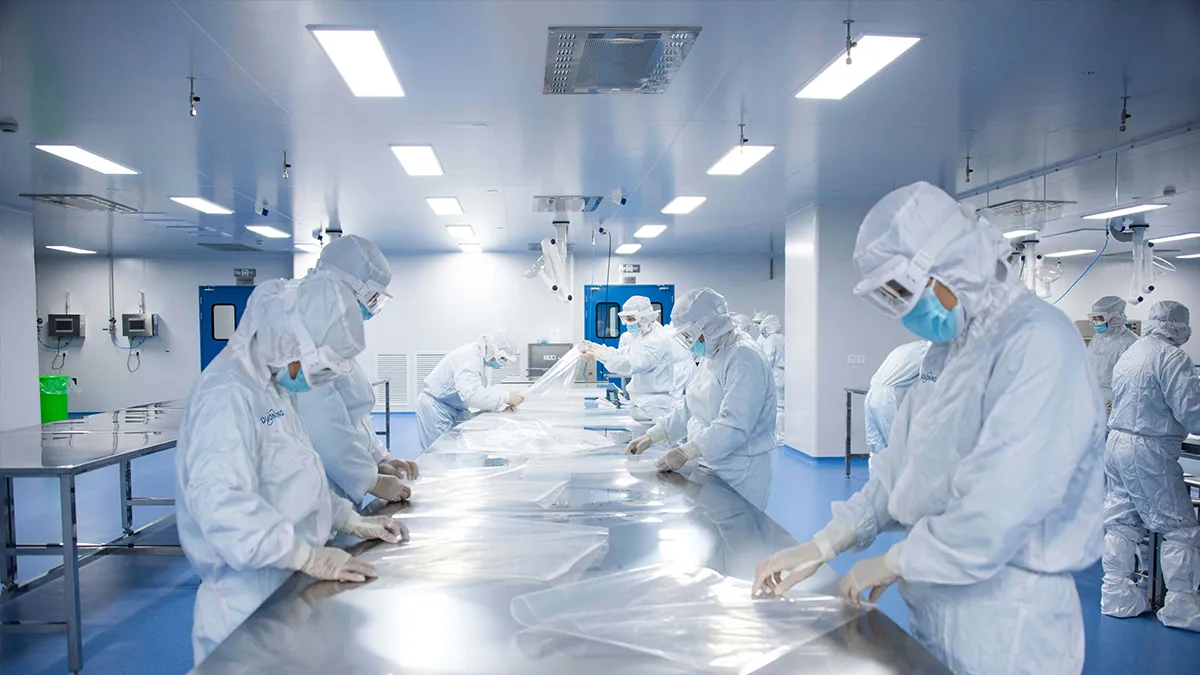
Good Manufacturing Practice (GMP) environments in pharmaceutical facilities require rigorous environmental monitoring and contamination control. UV-C systems supplement terminal cleaning and continuous air filtration in classified areas (ISO Class 5-8 cleanrooms) by providing an additional barrier against airborne and surface contamination.
Key use cases in pharma and biotech include:
- Aseptic processing zones — Upper-room and in-room UV-C installations reduce bioburden in critical ISO Class 5 areas
- Change room airlocks — UV-C in anteroom air circulation systems reduces gowning contamination risk
- Water system polishing — UV-C reactors at the point of use provide final barrier disinfection for purified water loops
- Equipment surface disinfection cycles — UV-C robot systems or fixed overhead arrays for non-product-contact surface treatment between batches
Industrial Manufacturing and Assembly
Electronics assembly, optical component manufacturing, and precision mechanical assembly facilities use UV-C for more specialized applications. UV-curable adhesives are widely used in electronics assembly, and UV-C LED curing systems provide the necessary photonic energy for these processes. Beyond curing applications, germicidal UV-C LEDs at 265-280 nm are increasingly deployed for equipment and work surface sanitation between shifts, reducing the downtime associated with chemical cleaning protocols.
Understanding UV-C Safety Standards and Regulations
Direct exposure to UV-C radiation is a documented health hazard. Unlike UV-A and UV-B, which affect skin and eyes over longer exposure periods, UV-C at germicidal intensities can cause photokeratitis (a painful corneal inflammation) and erythema (skin burn) within seconds to minutes of exposure. This makes safety engineering — fixture shielding, occupancy sensors, interlock systems, and procedural controls — non-negotiable in any industrial UV-C installation.
ACGIH TLV and IEC Standards
The ACGIH (American Conference of Governmental Industrial Hygienists) sets the Threshold Limit Value (TLV) for occupational UV-C exposure at 0.1 mW/cm2 (100 uW/cm2) for an 8-hour TWA (time-weighted average). These values are the basis for most industrial safety guidelines.
IEC 62471 (Photobiological Safety of Lamps and Lamp Systems) classifies UV lamps into Risk Groups:
- Risk Group Exempt (RG0) — No UV hazard under any reasonable use condition
- Risk Group 1 (RG1) — UV hazard only for long-term exposure or unusual conditions
- Risk Group 2 (RG2) — UV hazard only for exposure durations longer than 0.25 seconds
- Risk Group 3 (RG3) — Hazardous even for brief exposure — requires engineering controls and restricted access
Industrial UV-C disinfection fixtures used in occupied or semi-occupied spaces should be designed to Risk Group 2 or lower, with appropriate interlocks that reduce output or shut off the system when motion or occupancy is detected in the disinfection zone.
Food Industry Regulatory Requirements
Food processing facilities using UV-C systems must ensure that equipment does not introduce food contact hazards. Under FDA 21 CFR Part 110 and the FSMA (Food Safety Modernization Act), UV-C systems used in food facilities must be designed and installed to prevent any possibility of product or packaging contamination from fixture materials, broken components, or condensation ingress.
For food contact surface applications, NSF International maintains Protocol 51 — Food Equipment Units — which sets construction and material safety requirements for UV systems used in food processing environments.
How to Specify UV-C LED Fixtures for Industrial Applications
Fixture specification for UV-C LED systems involves several parameters beyond those used in conventional industrial lighting selection.
UV-C Output and Dose Calculation
The primary specification is the UV-C radiant flux in milliwatts (mW) or microwatts (uW) per module. From this, combined with the fixture’s beam angle and mounting height, you can calculate the irradiance (uW/cm2) at the target surface and estimate the dose for a given exposure time.
A practical approach for conveyor and surface disinfection applications:
- Determine the required log reduction for your process (typically 3-log for food contact surfaces, 1-3-log for air disinfection)
- Identify the target pathogen and its UV susceptibility coefficient (D10 value — the dose required for 90% inactivation)
- Calculate dose = irradiance x time; size the fixture array to achieve required dose at the minimum exposure time available in your process
- Apply a safety factor of 1.5-2x to account for lamp age, surface reflectivity, and environmental variables
Mounting Configuration and Fixture Form Factors
Common industrial UV-C LED fixture types include:
- Overhead linear modules — Suspended or surface-mounted linear UV-C LED arrays for air disinfection in HVAC ducts, cold storage rooms, and change rooms. Typically 20-200 mW output per module, arranged in arrays for coverage.
- Robotic mobile units — Self-propelled UV-C robots that autonomously navigate facility floors, delivering high-dose surface disinfection to warehouse, production, and storage areas between shifts. Common in pharma and food facilities with large floor plates.
- Conveyor-mounted arrays — Fixed UV-C arrays positioned above or beside food processing conveyor lines, designed to treat packaging, product surfaces, or equipment contact zones at line speed.
- Air handling unit (AHU) integration — UV-C LED modules installed inside air handling units and supply ducts for continuous air disinfection in HVAC systems. These are among the most cost-effective UV-C applications for large facilities.
- Water disinfection reactors — Flow-through UV-C LED reactors for point-of-use water treatment. These require separate specification methodology based on flow rate and required dose.
Maintenance Considerations for Industrial UV-C LED Systems
Unlike mercury UV lamps, which lose significant output within their rated life and require scheduled replacement, UV-C LEDs age more gradually. However, LED module output does degrade over time — typically quoted as L70 at 50,000-100,000 hours (the point at which output falls to 70% of initial). In industrial environments with elevated temperatures or humidity, the degradation rate may be faster than laboratory conditions suggest.
Maintenance best practices for industrial UV-C LED systems include:
- Periodic dosimetry validation — Use calibrated UV-C dosimeter cards or a UV radiometer to measure output at the target plane. Compare against baseline measurements taken at commissioning to assess degradation.
- Lens and filter cleaning — UV-C LED fixtures use quartz or specialized polymer lenses to transmit germicidal wavelengths. Dust, oil, and mineral deposits from industrial environments reduce UV transmission. Establish a cleaning schedule aligned with your facility’s production cycle.
- Fixture inspection and sealing — In wet or humid areas (washdown zones, cold storage with condensation), verify IP rating integrity annually. Broken seals allow moisture ingress, which degrades LED performance and creates electrical safety risks.
- Controller and sensor calibration — Occupancy sensors, UV dose controllers, and IoT monitoring systems require periodic calibration to maintain accuracy. Annual recalibration is standard for calibrated instrumentation in regulated industries.
UV-C LED vs. Chemical Disinfection: Making the Choice
UV-C and chemical sanitation methods are not mutually exclusive — in most industrial settings, they are used in combination. Understanding the strengths and limitations of each helps facility managers allocate disinfection resources appropriately.
Chemical disinfection (chlorine-based agents, peracetic acid, hydrogen peroxide, quaternary ammonium compounds) is effective and well-understood, but it introduces process constraints: contact time requirements, rinse steps, waste disposal, worker safety data sheet (SDS) requirements, and the risk of chemical residues in food or pharmaceutical applications.
UV-C LED provides a non-chemical, residue-free alternative that can operate continuously without process interruption. Its limitations are shadowing — surfaces not in direct line of sight to the UV-C source receive no dose — and the need for sufficient exposure time to achieve target log reductions.
The practical framework is to use chemical sanitation for deep cleaning and terminal disinfection where residue is manageable, and UV-C for continuous air disinfection, conveyor belt treatment, and high-frequency touch point treatment where the speed of non-chemical disinfection provides an operational advantage.
Frequently Asked Questions (FAQ)
Q: At what wavelength do UV-C LEDs work best for germicidal disinfection?
A: The peak germicidal effectiveness for most bacteria and viruses occurs at approximately 265 nm. UV-C LEDs operating in the 260-280 nm range provide the best balance of germicidal efficiency and practical LED chip performance. Some advanced systems use 222 nm (far UV-C), which early research suggests may inactivate pathogens while presenting lower photobiological hazard to human skin and eyes, though regulatory acceptance and long-term safety data are still evolving.
Q: Is UV-C safe for use in occupied industrial spaces?
A: Yes — when properly designed and installed. Upper-room UV-C installations, where fixtures are mounted at heights above 2.5 meters with shielding that prevents direct beam exposure to occupants, are widely used in occupied industrial facilities. The key requirements are: proper fixture shielding, accurate irradiance calculations for the occupied zone, and interlocks that reduce output when personnel enter the treatment zone. Always consult a qualified industrial hygienist or lighting engineer before installing UV-C in occupied spaces.
Q: Can UV-C LED lighting be integrated with existing building management systems?
A: Yes. Most industrial UV-C LED fixtures support 0-10V dimming, PWM control, or digital protocols such as DALI-2 and BACnet. Many manufacturers offer IoT-enabled fixtures with cloud-based monitoring and control dashboards that integrate with facility BMS platforms. This enables scheduled operation, dose logging for regulatory compliance, and automated alerts for fixture maintenance or output degradation.
Q: How do I calculate the number of UV-C fixtures needed for my facility?
A: Start with the target UV dose (mJ/cm2) for your application and pathogen. Then, using the fixture manufacturer’s photometric data — which should specify irradiance at various mounting heights and angles — calculate the coverage area per fixture. Divide your total target area by the effective coverage per fixture, then apply a safety factor of 1.5-2x for degradation and environmental conditions. For large facilities, request a professional UV-C lighting layout from the manufacturer, which should provide point-by-point dose calculations and CAD floor plans.
Q: What is the expected return on investment for UV-C LED installation in industrial settings?
A: The ROI calculation depends heavily on the application. In food processing, where reduced chemical sanitizer usage, lower product rejection rates, and reduced cleaning labor all contribute to the business case, payback periods of 2-4 years are achievable. In pharmaceutical and biotech facilities, the primary value is contamination control and regulatory compliance — metrics that are harder to quantify directly but carry significant risk-reduction value. Many facilities achieve positive ROI through reduced cleaning chemical procurement costs, faster changeover times between production runs, and lower utility costs compared to maintaining separate chemical dosing and ventilation systems.
Q: Can UV-C LED systems be used in hazardous (classified) industrial locations?
A: UV-C LED fixtures used in areas classified as hazardous under NEC or ATEX standards must be rated accordingly — typically as Explosion-Proof (XP) or Intrinsically Safe (IS) equipment. Not all UV-C LED fixtures carry these ratings; verify the NEC Class/Division or ATEX Zone rating for your specific installation location before specifying.
Why Choose Recolux for Industrial UV-C LED Disinfection Lighting?
At Recolux, we engineer industrial-grade UV-C LED disinfection systems purpose-built for the demands of food processing, pharmaceutical, and cold chain environments. Our product range covers:
- UV-C LED linear disinfection modules for HVAC integration and upper-room air disinfection
- UV-C LED conveyor arrays for continuous food contact surface treatment
- Cold storage UV-C LED fixtures rated for sub-zero operation in blast freezers and cold chain facilities
- Hazardous-area UV-C LED luminaires rated for NEC Class I/II and ATEX Zone applications
Every Recolux UV-C LED fixture ships with independent third-party germicidal efficacy testing data, photobiological safety classification (IEC 62471), and full photometric and radiometric documentation for your engineering and regulatory submissions. Our team provides complimentary UV-C dose mapping and fixture layout calculations for facilities planning new installations.
Ready to explore how UV-C LED disinfection lighting can fit into your facility’s contamination control program? Explore our full range of industrial UV-C LED products or contact our technical sales team to discuss your application requirements.